

Is the right corporate chauffeur service the most prestigious vehicle in the fleet, or the arrangement that best supports the day’s business commitments? Comfort and presentation matter, but so do punctual coordination, privacy and the ability to manage a changing itinerary. Start with the journey, not the badge on the bonnet.
For executives, clients and delegates, transport is part of the professional experience. A considered plan can ease the work of coordinating transfers between flights, meetings and accommodation, while matching each traveller with a suitable vehicle. It also gives organisations a clearer way to assess service quality beyond general claims of luxury.
This guide explains how to compare corporate chauffeur options, identify your organisation’s practical requirements and choose an arrangement suited to its business journeys. We’ll cover itinerary planning, service standards and vehicle categories, from Mercedes-Benz E-Class and S-Class models to Range Rover SUVs and Mercedes-Benz V-Class executive vans. DUMBABLACK PREMIUM CHAUFFEUR provides corporate and diplomatic chauffeur transport, with journeys shaped around each booking.
Key Takeaways
- Start with the itinerary and traveller’s needs, then choose a vehicle category that suits the journey.
- Assess a corporate chauffeur service by its professionalism, privacy and coordination, not by luxury claims alone.
- Compare chauffeur transport, rideshare and self-drive according to journey complexity, company policy and the level of control required.
- Use a simple scorecard to weigh journey fit, service standards, privacy, vehicle choice and coordination for different traveller groups.
- Consider how DUMBABLACK’s executive sedans, luxury SUVs and Mercedes-Benz V-Class can support business travel.
What a Corporate Chauffeur Service Should Deliver for Business Travel
A corporate chauffeur service is pre-arranged, chauffeur-driven private transport for employees, executives, clients or delegates travelling on business. It combines a planned journey with a professional driver, allowing an organisation to arrange transport around the traveller and itinerary rather than relying on an unplanned trip-by-trip decision. The chauffeur’s role extends beyond driving, as outlined in this overview of chauffeur services.
Business travel has different priorities from a leisure journey. A traveller may need to arrive composed for a meeting, have privacy between commitments or be received in a way that reflects the organisation’s standards. A well-planned arrangement accounts for these needs without treating a premium vehicle as the answer to every transport requirement.
Not every work journey calls for a chauffeur. Another transport option may suit a short trip with a flexible schedule, while a pre-planned journey involving several commitments, visiting guests or a formal arrival may benefit from dedicated coordination. Choose according to the purpose, schedule and traveller’s needs.
Which business journeys may suit a corporate chauffeur?
Common uses include executive journeys, transport for visiting clients, delegate movements and airport transfers. A chauffeur-driven arrangement may also suit a day with several meetings, multiple stops or changes in timing. Sharing the itinerary in advance gives the journey a clear structure and helps the organisation plan the sequence of commitments instead of arranging each trip in isolation.
For example, a visiting delegate may need an airport transfer, transport to accommodation and a series of business appointments. An executive may need a private journey between meetings, with time to prepare for the next discussion. These examples help with planning; they do not mean every employee or every leg of a trip requires a chauffeur.
What should business buyers expect from the arrangement?
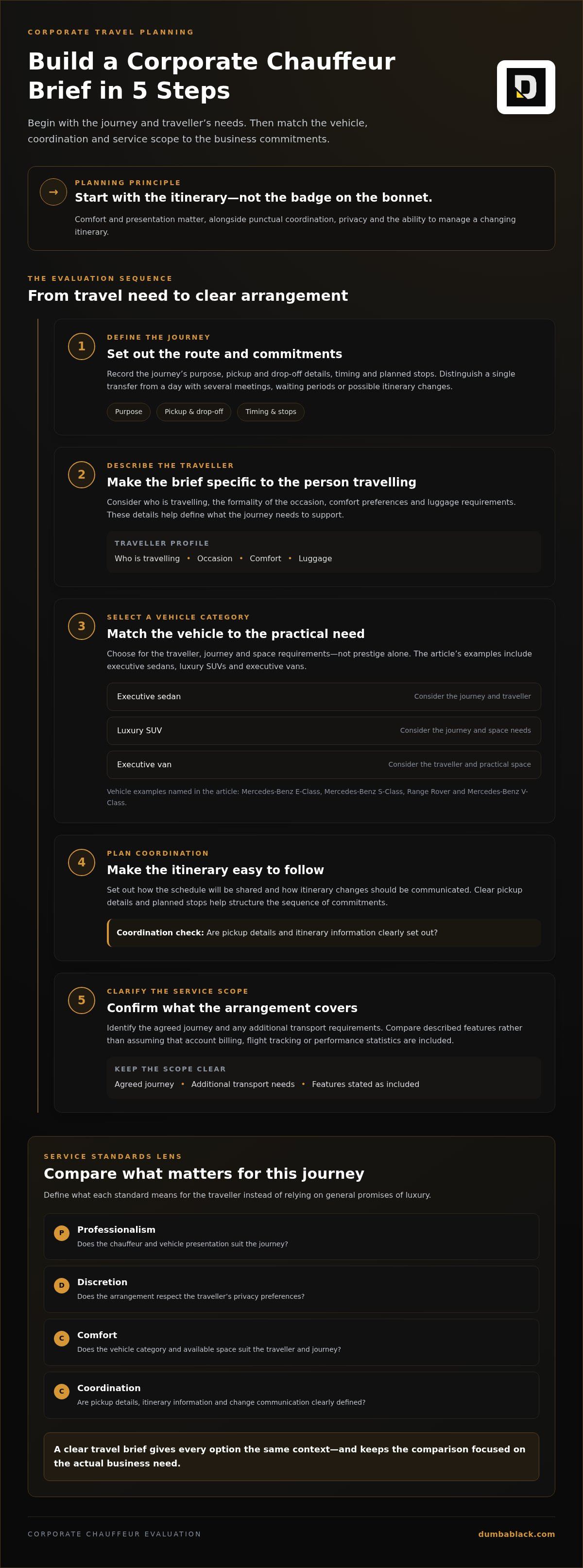
Assess the arrangement against the traveller’s needs and itinerary. Professional presentation, discretion, comfort and clear coordination are useful priorities. Define what each means for the journey, rather than relying on a general promise of luxury.
- Professionalism: Consider how the chauffeur and vehicle presentation suit the journey.
- Discretion: Consider whether the arrangement respects the traveller’s preference for a private, composed journey.
- Comfort: Match the vehicle category and available space to the journey and traveller.
- Coordination: Set out pickup details, stops and how itinerary changes should be communicated.
A concise itinerary, traveller profile and clear priorities make it easier to define a suitable arrangement. The aim is not to add formality for its own sake, but to ensure transport supports the business purpose with care and professionalism.
How to Evaluate a Corporate Chauffeur Service Before Choosing
Start the comparison with a clear travel brief. Without one, an organisation can end up weighing vehicle prestige or advertised extras instead of checking whether the arrangement fits the journey. Define what is essential, what is preferred and what the itinerary requires before reviewing options.
Which requirements should a company define first?
Record the journey’s purpose, schedule, traveller profile, luggage needs and relevant preferences. Distinguish a single transfer from a day involving several meetings, waiting periods or possible changes in plan. This brief gives every option the same context, so the comparison reflects the actual travel need rather than a list of attractive features.
Use this sequence to shape the brief and assess the arrangement:
- Define the journey. Set out its purpose, pickup and drop-off details, timing and planned stops.
- Describe the traveller’s needs. Consider who is travelling, the formality of the occasion, comfort preferences and luggage requirements.
- Select a vehicle category. Match the vehicle to the traveller, journey and practical space needs rather than choosing by prestige alone.
- Plan the coordination. Explain how the schedule will be shared and how itinerary changes should be communicated.
- Clarify the service scope. Identify what the arrangement covers, including the agreed journey and any additional transport requirements.
How should buyers assess service standards?
Separate essentials from preferences. A suitable vehicle category and clear coordination may be essential for one journey; a particular finish or added convenience may be a preference. Assess professionalism, discretion and communication against the traveller’s needs, and compare features described as part of the arrangement.
Do not assume account billing, flight tracking or performance statistics are included. These are specific features, not standard assumptions for a comparison. Use a checklist to keep the review consistent:
- Professionalism: Does the described service suit the formality of the journey?
- Discretion: Does the arrangement account for the traveller’s privacy preferences?
- Communication: Are pickup details and itinerary information clearly set out?
- Vehicle category: Is the proposed category appropriate for the traveller and luggage?
- Coordination: Does the service scope address the journey’s stops and planned commitments?
Compare like with like. A single airport transfer and a day of appointments have different coordination needs, so the same service description may not suit both equally well. If the itinerary changes, clear communication about updates is more useful than a broad claim of flexibility.
For organisations considering a corporate chauffeur service, DUMBABLACK’s corporate travel arrangements can be assessed against these practical requirements. A well-defined brief gives the planning process a clear starting point.
Corporate Chauffeur Service Compared with Rideshare and Self-Drive
A dedicated chauffeur isn’t necessary for every business journey. Another mode may suit a straightforward trip with flexible timing, while a planned day of meetings or client-facing travel may call for more deliberate coordination. The right choice depends on journey complexity, traveller needs and company policy, not a universal ranking of transport options.
Use this comparison to identify practical differences. Details vary by arrangement, so treat the table as a guide to common planning considerations rather than a promise about every service.
| Consideration | Chauffeur transport | Rideshare | Self-drive |
|---|---|---|---|
| Planning | Usually arranged in advance around a specified journey or itinerary. | Often requested for an individual trip as needed. | Requires the traveller to arrange a vehicle and plan the journey. |
| Privacy | A private vehicle with a professional chauffeur; travellers should still follow their organisation’s policies for sensitive discussions. | A vehicle is shared with a driver who is not part of the traveller’s organisation. | The traveller controls who joins the journey, subject to the vehicle arrangement. |
| Driving responsibility | The chauffeur drives, leaving the traveller free from driving duties. | The rideshare driver drives the booked trip. | The traveller drives and remains responsible for the driving task. |
| Itinerary control | Can be planned around agreed stops and commitments. | Typically organised one trip at a time. | Offers direct control over the route and timing, with the traveller managing the journey. |
When may chauffeur-driven business transport be appropriate?
Consider it for a planned executive journey, client-facing transport or a schedule with several commitments. The value is not simply the vehicle: the organisation can plan around the day’s appointments, while the traveller leaves the driving to a professional. This can make sense when the traveller’s time, presentation or itinerary calls for focused attention.
Good planning still matters. Share relevant schedule details and understand the agreed service scope. A professional arrangement should not be treated as a guarantee of punctuality, confidentiality or a particular security outcome.
When might another transport mode meet the need?
For a simple point-to-point journey with no further stops, a rideshare or another suitable option may be enough. Self-drive can provide flexibility for travellers who are comfortable driving and whose organisation permits it, but the traveller retains responsibility for driving and related journey decisions. Weigh that responsibility against the demands of the trip.
DUMBABLACK provides chauffeur-driven corporate transport. For organisations considering a corporate chauffeur service, make the decision trip by trip: assess the schedule, traveller and level of itinerary coordination required, then choose the mode that fits company policy and the journey.
Build a Corporate Chauffeur Evaluation Framework for Your Organisation
A simple scorecard helps your organisation apply consistent standards to different journeys without treating every traveller or itinerary alike. Define the non-negotiables first, then record preferences separately. This keeps the evaluation focused on practical fit rather than a provider’s most prominent feature or a vehicle’s prestige.
How can a company turn requirements into decision criteria?
Start with the journey’s purpose, who is travelling, the itinerary, luggage needs and level of coordination required. Mark each item as essential or preferred. For example, an agreed vehicle category may be essential for a particular traveller, while a specific model may be a preference. Compare arrangements against the same brief, and assess features described as part of the service.
Use this scorecard as a discussion tool. Record whether each point meets the brief, needs clarification or is not relevant to that journey.
- Journey fit: Does the arrangement suit a single transfer, a sequence of appointments or another defined travel purpose?
- Professionalism: Does the described chauffeur service align with the standards expected for the traveller and occasion?
- Privacy: Does the arrangement reflect the traveller’s privacy needs and the organisation’s own policies?
- Vehicle category: Is the vehicle appropriate for the traveller, luggage and nature of the journey?
- Coordination: Are pickup details, planned stops and itinerary communication addressed clearly?
How can transport needs differ by traveller?
Apply the same criteria, but adjust their relative importance to the traveller and purpose. An executive may prioritise privacy and a composed arrival. A visiting client may need a considered welcome and clearly coordinated transfers. An employee travelling between routine commitments may value straightforward scheduling. A delegate itinerary may call for an executive van, while an individual journey may suit an executive sedan.
DUMBABLACK’s vehicle categories include the Mercedes-Benz S-Class and BMW 7 Series, Mercedes-Benz E-Class, Range Rover models and Mercedes-Benz V-Class. Consider these options against the scorecard rather than treating one as the default for every booking. Let the traveller profile and itinerary guide the choice, and assess suitability against the journey’s actual needs.
For a consistent review, retain the scorecard and brief for each journey type. Comparing an airport transfer with a day of meetings then becomes more useful: the criteria stay stable while the requirements and preferences change. A companion business travel chauffeur guide can also help employees prepare for a planned journey.
To discuss a corporate arrangement shaped around your organisation’s travel requirements, contact DUMBABLACK.
DUMBABLACK Corporate Chauffeur Service for Considered Business Travel
DUMBABLACK provides corporate and diplomatic chauffeur transport, with private journeys arranged around business requirements. The service can form part of a wider itinerary, whether transport is needed for an individual commitment or a longer business stay. The appropriate arrangement depends on the traveller’s plans and the purpose of the visit.
Which confirmed DUMBABLACK vehicles can suit business travel?
DUMBABLACK’s fleet includes executive sedans, luxury SUVs and an executive van. Rather than treating one vehicle as the default, consider how its category relates to the traveller’s itinerary and preferences. A sedan, SUV or van may suit different business travel needs.
- Executive sedan: A considered category for individual business travel.
- Luxury SUV: An alternative for itineraries better suited to an SUV.
- Executive van: A category to consider when the journey calls for a van.
These broad distinctions can guide the discussion without assuming specific capacity or equipment details. Use the journey brief as the basis for selecting a suitable arrangement.
How can chauffeur transport fit a wider business stay?
A business visit may involve more than a transfer. DUMBABLACK can arrange hotel or apartment stays alongside private ground transport, bringing accommodation and travel logistics into one considered itinerary. This can be useful when a visit includes several scheduled movements or extends across a wider programme.
For an itinerary beyond a single transfer, curated travel packages can bring accommodation and ground transport together. Consider how the stay and planned journeys relate to the purpose of the visit, then share those requirements when discussing the arrangement. This gives the itinerary a coherent shape without assuming every business traveller needs the same service.
DUMBABLACK’s corporate chauffeur service gives organisations a way to plan private transport as part of business travel. Explore DUMBABLACK corporate chauffeur services to consider an arrangement for your organisation’s next itinerary.
Set the Standard for Your Next Business Journey
A well-designed transport arrangement should reflect how your organisation wants its business travel to feel: considered, composed and aligned with each traveller’s needs. Use your evaluation criteria as a practical reference, then adapt them as itineraries and traveller requirements change. That keeps each booking purposeful without making every journey more elaborate than it needs to be.
DUMBABLACK’s stated clientele includes organisations such as UNDP, IFAD, Ericsson Botswana and Stanbic Bank. This gives context to the business and diplomatic travel it serves, while your organisation’s own requirements remain the right basis for choosing an arrangement.
When a journey calls for planned, chauffeur-driven transport, consider how a corporate chauffeur service can fit your organisation’s travel approach. Assess the itinerary, traveller and coordination required, then choose an arrangement suited to the journey.
View DUMBABLACK corporate travel options and discuss an arrangement for your next business journey.
Frequently Asked Questions
Is a corporate chauffeur service only for senior executives?
No. A corporate chauffeur service can suit any business traveller whose journey calls for planned, private transport. A company might arrange it for an employee carrying presentation materials to an important meeting, a visiting client unfamiliar with the travel arrangements or a delegate following a set programme. The decision should reflect the journey and the organisation’s policy, not job title alone.
How far in advance should a company arrange a corporate chauffeur?
There isn’t one advance-booking period that suits every journey. Arrange transport once the travel details are sufficiently clear, allowing more planning time when several travellers, stops or connected arrangements are involved. For a single transfer, the essential details may be simpler. Share the schedule, pickup information and traveller requirements together so the journey can be planned from a complete brief.
What should a corporate travel policy say about chauffeur transport?
A useful policy explains who may approve chauffeur transport, which journey circumstances justify it and how bookings should be documented. It can distinguish routine transfers from client-facing or multi-stop itineraries, set out acceptable vehicle categories and name the person responsible for communicating schedule changes. Include guidance on handling sensitive information during travel, and align the rules with the organisation’s existing travel and expense procedures.
Can a corporate chauffeur service guarantee privacy for business calls?
No transport arrangement should be treated as a guarantee of privacy for a business call. A private vehicle may offer a more contained setting than a shared space, but it cannot remove every confidentiality risk. Travellers should follow company information-handling rules, avoid discussing highly sensitive matters unless approved and use secure communication practices. Organisations can also state privacy expectations clearly when arranging transport.
Is DUMBABLACK’s corporate transport chauffeur-driven?
Yes. DUMBABLACK’s corporate transport is chauffeur-driven, with a professional chauffeur handling the driving while the traveller focuses on the business purpose of the journey, such as preparing for a meeting or reviewing materials. Organisations should account for their own travel policies when selecting a transport mode. For a chauffeur-driven journey, provide the itinerary and traveller requirements as part of the arrangement.
What is the difference between a corporate chauffeur service and a standard limousine service?
A corporate chauffeur service describes transport arranged around business travel, with attention to the traveller, itinerary and professional context. “Limousine service” can describe a vehicle style or a provider’s broader transport offering, so the label alone may not explain how a journey is arranged. Compare the actual service scope, vehicle category, communication and itinerary handling rather than relying on either term as a quality measure.
What should a company do when a business itinerary changes?
Share the revised details as soon as they are known. Provide the updated pickup time or location, any added or removed stops, and changes to the traveller or luggage requirements. Confirm that the revised arrangement has been acknowledged before relying on it. For a schedule involving several appointments, designate one person to communicate updates so the traveller and transport team receive a consistent itinerary.

