

The route and level of service matter as much as the distance. A luxury safari lodge overland transfer is shaped by the journey’s route, passenger count, vehicle choice and included arrangements. Its price depends on these details and is provided after a quotation request.
It’s reasonable to want a clear picture of both cost and comfort before arranging travel between a town, airport or lodge. A transfer can involve more than time on the road: the vehicle must suit the group and luggage, while the route determines how the journey fits into the wider itinerary.
This article explains how route planning, group size and travel style influence the experience, and what to clarify when comparing inclusions. It also outlines how comfort choices affect the journey, so you can plan a transfer that fits your safari itinerary with greater confidence.
Key Takeaways
- Compare routes by pickup point, lodge access and itinerary fit, not distance alone.
- Separate ground transport from lodge stays, activities and other inclusions to understand what each arrangement covers.
- Match the vehicle and travel style to your group’s size, luggage and preference for privacy or shared travel.
- Plan journey timing around the route and conditions, and weigh comfort and coordination alongside cost.
Choosing a route and checking what the price includes
The route shapes the journey, its timing and the arrangements required. Compare the pickup point, lodge access and the journey covered by your quote.
Route Selection
An overland transfer connects a starting point with a lodge by road. Its suitability depends on where the journey begins, the destination and the wider itinerary. For example, travellers heading from Maun to an Okavango Delta lodge should consider how the road journey fits their arrival plans. A direct route may reduce interruptions, while a planned stop can suit an itinerary with several destinations.
First, identify the exact pickup and drop-off points. Then compare route options with lodge check-in, planned activities and onward travel. Consider a luxury safari lodge overland transfer as part of the full itinerary, not an isolated drive. This makes it easier to spot inconvenient connections or unnecessary backtracking before confirming arrangements.
Transfer Duration
Transfer duration is the time needed to travel by road between the pickup point and lodge. It matters because the journey affects arrival timing and the shape of the day. A trip from an airport differs from one beginning at a hotel or another lodge, even when both end at the same destination. Route conditions, stops and access arrangements also affect the schedule.
Build the transfer into the itinerary before setting plans for arrival day. For instance, don’t treat a road journey from Maun as interchangeable with a short airport pickup. Share your flight arrival point, lodge name and any planned stops when arranging the route. These details help align pickup timing with the actual journey, rather than relying on distance alone.
Charter Flights and Overland Transfers
Overland transfers travel by road, while charter flights move guests by air. The best fit depends on the route, itinerary, luggage and preferred travel style. Road travel can connect a town, hotel or airport with a lodge. A charter flight may suit an itinerary built around air connections between destinations. Compare each option’s pickup and arrival points, not just its time in transit.
For example, travellers starting in Maun can assess whether a road connection suits their lodge itinerary or an air leg fits better. Include onward transport at the destination in your comparison. A flight and a road journey may not cover the same door-to-door route, so map each stage before choosing.
Booking and Price Inclusions
Booking starts with the route, travel date, pickup location, lodge destination and passenger details. A quotation should make clear which journey stages it covers. The itinerary and vehicle requirements inform the quote, so provide the details needed to describe the full journey.
Before accepting, compare the written arrangements with your plans. Clarify whether the journey includes pickup at the airport or hotel, direct lodge drop-off, planned stops and any onward road segment. Also share relevant luggage and arrival details. A clear comparison helps distinguish the transfer from accommodation, activities or separate transport within the wider safari itinerary.
Group size and travel style
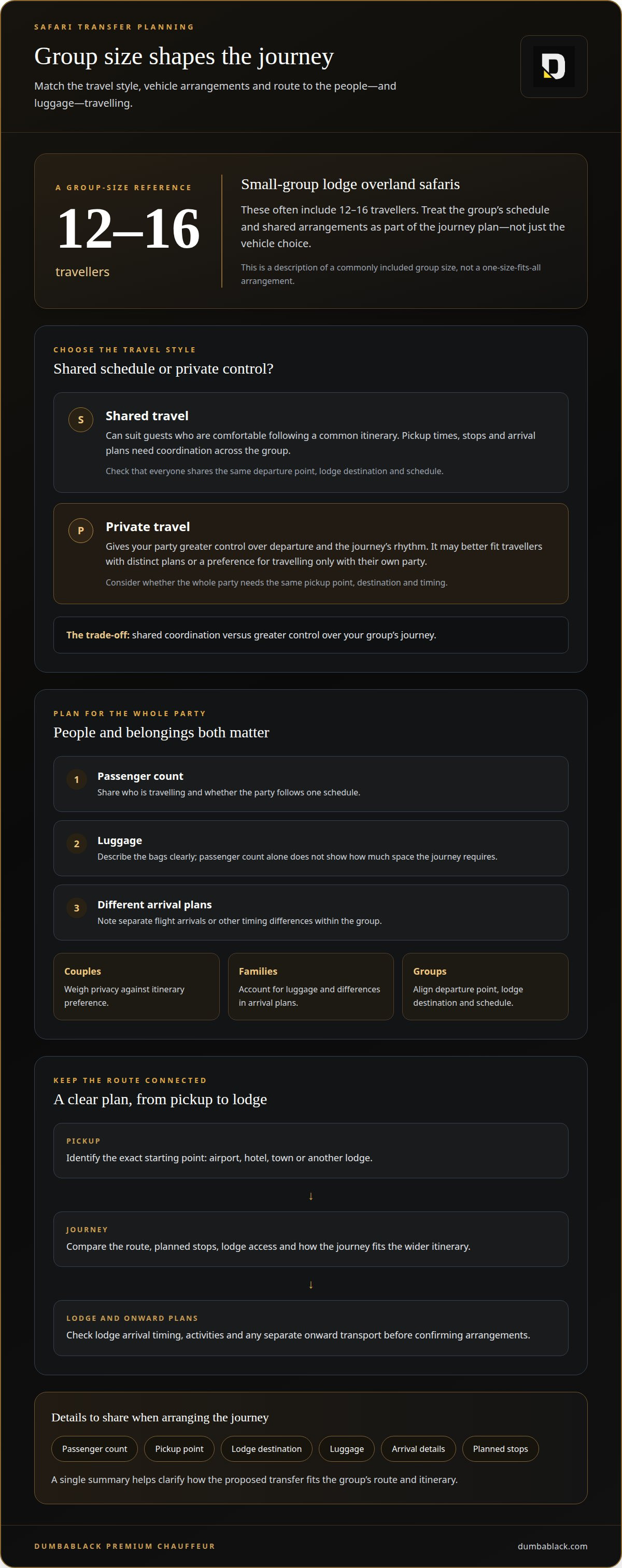
Passenger count influences how a safari group shares the journey and coordinates its plans. Small-group lodge overland safaris often include 12-16 travellers. A couple, family or private party may prefer a different arrangement. Consider who is travelling, how much luggage they carry and whether they value shared company or a private setting. These details help identify a travel style that suits the group, rather than simply choosing the largest vehicle available.
Shared travel can bring guests together around a common itinerary. It also means coordinating pickup times, stops and arrival plans across the group. For example, a party of 12-16 travellers may need a more structured departure than a couple travelling independently. Confirm how the route fits the group’s lodge plans, and whether everyone follows the same schedule. A coordinated itinerary reduces uncertainty about who is travelling together and where each journey begins.
Private travel gives your party greater control over departure and the journey’s rhythm. A family travelling with children or colleagues arriving on different flights may have different priorities from a shared group. Consider whether everyone needs the same pickup point, destination and timing. If plans vary, list each traveller’s arrangements before choosing a travel style. This makes the practical differences between a shared transfer and a private journey easier to assess.
- Couples: Compare shared travel with a private journey based on privacy and itinerary preference.
- Families: Account for each traveller’s luggage and any differences in arrival plans.
- Groups: Align the departure point, lodge destination and schedule before finalising arrangements.
Consider luggage alongside passenger numbers. The group’s bags affect how much space the journey requires, particularly when travellers carry different amounts. For instance, a family with several bags should provide a clear picture of its luggage when arranging a transfer. Don’t judge suitability by passenger count alone. Consider people and belongings together, then match the arrangements to the whole group.
Travel style also shapes the day. A shared itinerary may suit guests comfortable following a common schedule. A private arrangement can better fit travellers with distinct plans or a preference for travelling only with their own party. Compare the trade-offs directly: shared coordination versus greater control over your group’s journey. The right choice fits the lodge itinerary and travellers’ priorities.
Before booking, provide the passenger count, pickup details, destination and luggage information in one clear summary. Include any different arrival plans within the group. For a private safari journey or coordinated travel for colleagues, explore tailored journey arrangements as a next step.
Included activities, transport, and services
Safari itineraries can combine road transfers, lodge stays and scheduled activities. Separate each component to understand what the arrangements cover.
Transfer Vehicles
Transfer vehicles range from executive sedans and SUVs to an executive van, depending on the route and party. The choice matters because passengers, luggage and road access all affect suitability. A couple travelling from Maun may have different requirements from a family heading to an Okavango Delta lodge.
Ask which vehicle is planned and how it fits the itinerary. A sedan may suit a small party on an appropriate route, while a larger group may need more passenger space. Safari-area road conditions and lodge access also shape the practical choice. The vehicle type alone doesn’t establish whether a specific route is suitable.
Package Inclusions
Overland transfers may be included in a luxury safari package or arranged separately. The distinction matters because a lodge stay and its activities don’t automatically cover every transport leg. For example, a package covering accommodation in Botswana’s Okavango Delta may treat the journey from Maun as a separate arrangement.
Read the itinerary by journey stage. Identify the starting point, each lodge, the transport between them and any planned activities. Then distinguish transport from accommodation, meals and experiences in the written package details. This makes it easier to see whether an airport pickup, lodge connection or onward transfer forms part of the arrangements.
Luggage Limits
Luggage capacity depends on the vehicle, passenger count and bag dimensions. It matters because the vehicle must accommodate people and their belongings together. A family travelling with several large cases, for example, has different space needs from two guests carrying compact bags.
Share the number and type of bags when arranging ground transport. Don’t apply aircraft baggage allowances automatically to a road journey. Light-aircraft luggage limits on safari are typically 15-20 kg, and bags should be soft; those limits relate to flights, not every overland vehicle. If the itinerary combines road and air legs, assess luggage separately for each segment.
Distinguish activities from transport. A scheduled game drive at a lodge is not the same journey as a road transfer between Maun and the property. Check which activities appear in the itinerary and which transport legs connect them. This helps prevent assumptions about transfers based solely on an included lodge experience.
For a clear comparison, map each stage from arrival to lodge and onward travel. Record the vehicle, passenger count, luggage needs, activities and transfer legs beside each stage. A Botswana itinerary with an airport arrival, road connection and lodge stay shows why these details should be read together, but not treated as a single inclusion.
Safety and comfort considerations
Comfort and safety planning starts with the route, vehicle and passengers. On a journey from Maun to a Botswana lodge, identify the pickup point, destination and expected stops before departure. Match the vehicle to the passenger count and luggage, then set a schedule that allows for the actual road journey. A well-planned itinerary helps travellers prepare without treating every transfer as identical.
Passenger comfort depends on practical details throughout the drive. Travellers may prefer a quiet cabin, space for personal items or planned breaks on a longer route. Families should consider children’s needs; business travellers may value privacy between appointments. Share these priorities when arranging the journey so the vehicle and schedule reflect the people travelling, not only the distance between Maun and the lodge.
Safety preparation depends on the route and group. Keep the lodge name, pickup location and itinerary accessible to the lead traveller. Before setting off, ensure every passenger is seated and using a seat belt. Secure personal belongings rather than leaving them loose in the cabin. If the transfer includes several stops, make sure each traveller understands the next destination and meeting point.
- Route: Record the starting location, lodge destination and planned stops in Botswana.
- Passengers: Share the group’s needs, including children or travellers requiring additional consideration.
- Luggage: Keep bags arranged so they don’t obstruct passengers or access to seats.
- Timing: Coordinate pickup and lodge arrival plans with the day’s itinerary.
Comfort also depends on choosing a suitable vehicle. A sedan may fit a small party with limited belongings, while an estate or SUV may better suit different passenger and luggage needs. The Business Class Mercedes-Benz E-Class Estate is one option for travellers considering an estate. Choose based on the whole group and journey, not appearance alone.
For a transfer linked to an airport arrival, allow time for the handover from flight to road travel. For example, a traveller arriving in Maun with checked luggage needs a clear transition from airport pickup to the onward journey. Keep flight details, passenger names and the lodge destination together in the itinerary. This reduces confusion if travellers arrive on different flights.
Finally, review the day’s plan against each passenger’s needs. A couple prioritising privacy may make different choices from colleagues travelling together. Families may need a more deliberate pace than guests travelling light. For any safari lodge transfer, settle the route, luggage arrangements, pickup point and arrival plan before travel. These practical details support a composed journey from departure to lodge arrival.
How long do overland transfers to safari lodges take?
There is no single journey time for every safari lodge transfer. The route, starting point, road conditions, stops and final lodge access all shape the schedule. A transfer from Maun to an Okavango Delta lodge differs from one beginning at a hotel elsewhere. Plan around the actual pickup and destination, not a general estimate for the region.
Distance is only part of the calculation. Two routes of similar length can take different times if road conditions or access arrangements differ. A lodge reached by a direct road connection may involve fewer stages than one requiring additional travel after the main drive. Ask for the planned route and pickup-to-drop-off schedule, then arrange other commitments around the journey.
Stops also affect the expected arrival time. A transfer with a meal break or passenger pickup has a different schedule from a direct journey. For example, travellers leaving Maun with a planned stop should allow for it before scheduling a lodge activity. Share all intended stops when arranging the itinerary so the plan reflects the complete journey, not just driving time.
Departure timing matters when a road transfer connects with a flight or lodge check-in. For an airport pickup in Maun, provide the flight arrival details and lodge destination together. The itinerary can then account for the transition from airport to vehicle and the onward journey. Avoid scheduling a fixed activity immediately after arrival unless the transfer plan allows for it.
Use these details to understand the journey’s likely duration:
- Starting point: Name the airport, hotel, town or lodge where the vehicle collects you.
- Destination: Give the lodge’s full name and location, especially for a remote property.
- Route: Identify planned stops and any additional pickup points.
- Arrival plan: Note flight connections, check-in timing or a scheduled lodge activity.
For a multi-lodge safari, assess each transfer separately. A journey from one Botswana lodge to another may take a different route from the initial trip out of Maun. Record each departure point, destination and planned stop in sequence. This makes gaps between accommodation, transport and activities easier to identify, and avoids assuming every road leg takes the same time.
When comparing a road journey with a charter flight, compare the complete door-to-door itinerary. Include travel to the departure point, the arrival location and any onward ground connection. A flight may shorten one leg while still requiring transport at either end. A road transfer may connect locations more directly. Choose based on the full route and plans, not the travel mode alone.
For a carefully coordinated journey between an airport and lodge, request a transfer quotation with your pickup point, destination and itinerary details.
DUMBABLACK - The Spirit of Africa: Airport Transfers
DUMBABLACK, The Spirit of Africa, provides Airport Transfers and Safari & Lodge Transfers to connect airport arrivals with onward safari travel. This is a practical option when your itinerary includes a road journey from the airport to a lodge or coordinated transport between travel stages. Share your arrival point, lodge destination, passenger details and luggage needs so the journey can be planned around your itinerary.
For corporate itineraries, Corporate Travel can support coordinated ground transport. Weddings & Events is also available when travel forms part of a planned occasion. Keep your request focused on the route and schedule, especially when an airport pickup connects directly with a lodge transfer.
Contact DUMBABLACK - The Spirit of Africa at [email protected] to discuss your safari transfer arrangements.
Set the Journey Up for a Seamless Arrival
As you finalise your safari itinerary, treat the road transfer as part of the experience, not merely a connection between destinations. A well-planned luxury safari lodge overland transfer gives arrival day a clear structure and helps each part of the journey fit together. Keep the final itinerary consistent across your travel party, lodge arrangements and transport details. A shared reference makes changes easier to manage and helps everyone understand what happens next.
DUMBABLACK, The Spirit of Africa, can coordinate airport connections and transport for planned occasions. Share your route and travel plans to begin arranging the journey. Request an instant quote and expect a reply within one hour.
Contact DUMBABLACK - The Spirit of Africa to discuss your arrangements, and move forward with confidence.
Frequently Asked Questions
What is an overland transfer to a luxury safari lodge?
An overland transfer can be one way for travellers to reach a safari lodge by road. It can form one part of a larger itinerary, such as travel from an airport to accommodation before continuing to a lodge. Treat each leg as a separate arrangement in your schedule, especially if pickup points or vehicles differ. This keeps the transfer distinct from lodge accommodation and scheduled safari activities.
How much do luxury safari lodge overland transfers cost?
The quote depends on your route, vehicle, passenger requirements and journey arrangements. DUMBABLACK, The Spirit of Africa, provides an instant quote with a reply within one hour. For a useful estimate, share your pickup and drop-off points, travel date, passenger count and luggage needs. Include any stops or additional transport legs, since these details define the journey covered by the quotation.
Are safari lodge overland transfers safe and reliable?
Professional planning and defensive-driving practices are important parts of a well-managed transfer. DUMBABLACK, The Spirit of Africa, chauffeurs are defensive-driving certified and security-trained. Provide accurate passenger and itinerary details, and keep your lodge contact information accessible during travel. For an airport connection, share flight details so the pickup can be coordinated with your arrival. A clear itinerary helps travellers understand the planned journey and handover points.
Which routes and border-crossing rules affect overland safari transfers?
Routes crossing between Botswana, South Africa, Zimbabwe, Zambia or Namibia involve border formalities as well as road planning. Entry requirements depend on your nationality, destination and crossing point, so review the relevant government guidance before departure. Keep travel documents accessible and allow for border processing when arranging onward connections. For a multi-country itinerary, map each transport leg and crossing separately rather than treating the journey as one uninterrupted drive.


