

The shortest leg of a business trip can be the hardest to budget. There is no fixed percentage of total travel costs allocated to business trip ground transportation: its share depends on the destination, the number of journeys and how an executive moves between meetings. A single transfer creates a different cost pattern from a day with multiple stops.
That uncertainty is familiar to travel managers and executives balancing a schedule with a clear travel budget. The useful comparison is not simply one fare against another, but the full ground-transport plan: transfers, waiting time, parking, tolls and the time needed to manage each journey. This guide explains how those factors shape business travel costs, when rail, taxis, rideshares or rental cars may suit an itinerary, and when a pre-booked chauffeur can provide a more coordinated option. It also explains how to match a chauffeured sedan, SUV or executive van to the traveller, group and schedule.
Key Takeaways
- There is no universal percentage of a business travel budget allocated to ground transport; the share depends on the itinerary, destinations and number of journeys.
- Choose transport around the schedule: rail can suit some city-to-city journeys, while a pre-booked chauffeur can simplify airport transfers and tightly timed meetings.
- Match the vehicle to the trip. A chauffeured sedan or SUV suits individual executives, while an executive van can accommodate a group travelling together.
- For meetings and conferences, plan transfers between arrival points, hotels and venues as one coordinated itinerary rather than separate journeys.
- Compare the full travel arrangement, including tolls, parking, fuel and surcharges, as well as the time needed to manage each option.
What ground transportation option works best for executive business travel?
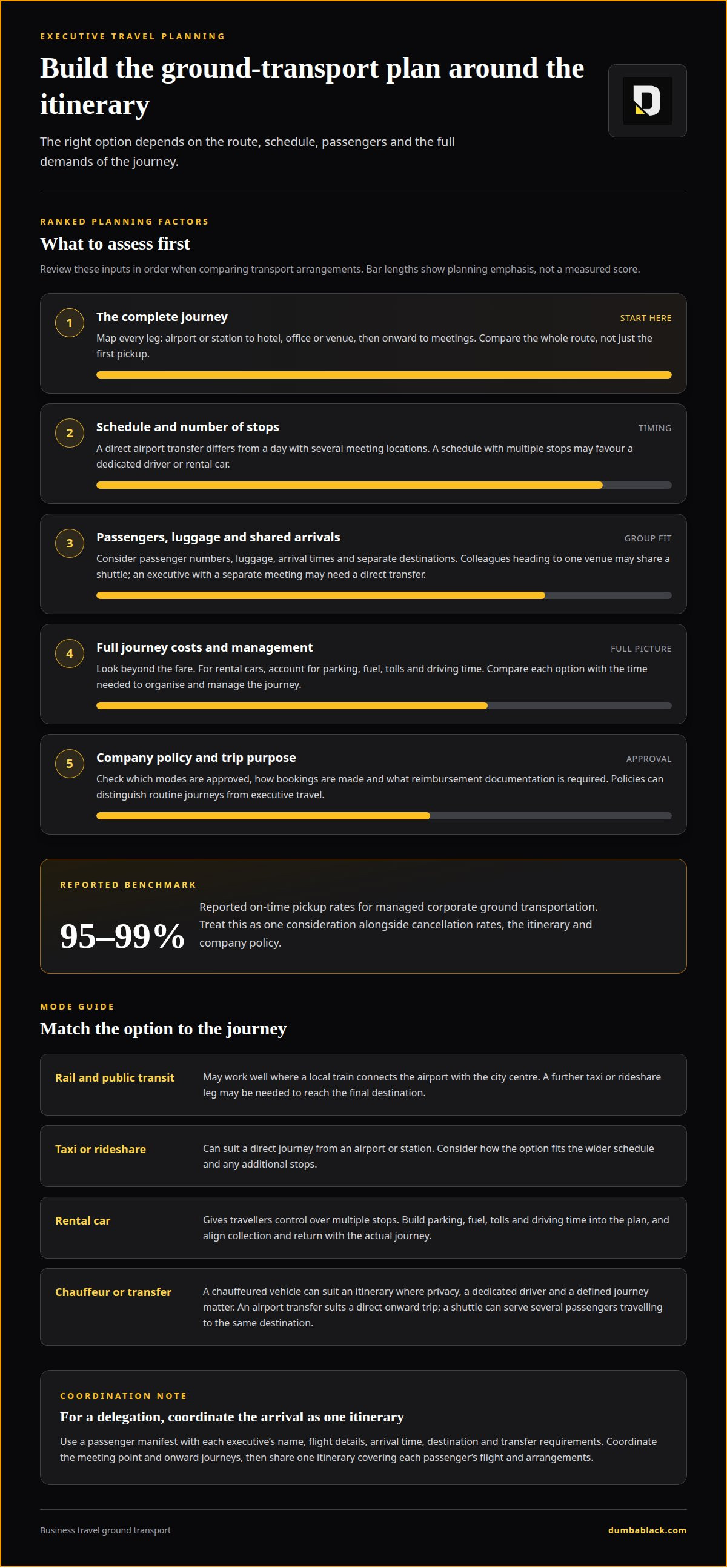
The right choice depends on the destination, meeting schedule, passenger count and company travel policy. For visiting executives, include the airport arrival and onward transfer in the same itinerary.
Airport Arrival Coordination
Start with a passenger manifest listing each executive’s name, flight details, arrival time, destination and transfer requirements. A delegation arriving on separate flights may need individual pickups, while colleagues on the same flight can travel together. Use the manifest to coordinate the airport meeting point and onward journeys. Flight details also help the transport coordinator respond to schedule changes.
Transfer and Shuttle Services
An airport transfer suits an executive travelling directly to a hotel, office or meeting. A shuttle can serve several passengers heading to the same destination, making it useful for a conference group or visiting delegation. The choice depends on arrival times, luggage, passenger numbers and whether the itinerary includes separate stops. For example, colleagues going to one venue may share a shuttle, while an executive with a separate meeting may need a direct transfer.
Ground Transport Option Comparisons
Rental cars give business travellers control over multiple stops, but the itinerary must account for parking, fuel, tolls and driving time. Taxis and rideshares can suit a direct journey from an airport or station. Public transit may work well where a local train connects the airport with the city centre. On cross-country trips in the United States, travellers will most likely fly, then use a rideshare or taxi to reach their destination.
A corporate travel policy should explain which modes are approved for different trip purposes, how bookings are made and what documentation is required for reimbursement. It can distinguish routine journeys from executive travel, then specify when a rideshare, rental car or executive car service is appropriate. Clear rules help employees choose consistently and give travel managers a practical basis for reviewing expenses.
Book airport transfers or rental cars once flights and meeting plans are settled. Early coordination gives the transport plan time to account for passenger details, arrival schedules, vehicle needs and destination. For a delegation, provide one itinerary listing each passenger’s flight and onward arrangements. For a rental car, align collection and return plans with the actual journey.
Before confirming the mode, map each leg from the airport to the hotel, office or event venue. A train may bring a traveller into the city centre, followed by a short taxi or rideshare journey. A schedule with several meeting locations may favour a dedicated driver or rental car. Compare the whole route, not just the first airport pickup.
For managed corporate ground transportation, on-time pickup rates are reported at 95 to 99 per cent. Treat that figure as one consideration alongside cancellation rates, the itinerary and company policy. The best option is the one that fits the executive’s schedule and trip requirements without adding unnecessary transfers.
Chauffeured cars, limousines, and SUVs
A chauffeured vehicle can suit an executive itinerary when privacy, a dedicated driver and a defined journey matter. Choose the vehicle by considering the passenger’s working needs, luggage and destination, not appearance alone.
Executive Vehicle Choices
A chauffeured car can provide a quiet setting for an executive travelling between appointments. A limousine may suit formal occasions or a guest who values extra space and privacy. An SUV may be appropriate when the route or luggage calls for a different vehicle format. Before choosing, consider who will travel, what they will carry and whether the vehicle must also accommodate presentation materials or event attire.
Executive Chauffeur Services
Executive chauffeur services coordinate a professional driver with the passenger’s travel requirements. Beyond driving, the chauffeur follows agreed instructions, assists with entry and exit where appropriate, and adapts communication to the passenger’s preferences. A corporate travel partner should clarify the expected manner of service, luggage assistance and planned stops. Clear expectations help the passenger and chauffeur begin the assignment with a shared understanding.
Private chauffeur safety procedures should make the journey identifiable and well organised. Provide the passenger with the vehicle description, driver identification process and confirmed pickup details through the established booking channel. At collection, the passenger can discreetly verify the booking before entering. If plans change, communicate through the agreed contact route so the updated destination reaches the right people.
Privacy also requires restraint. A chauffeur should receive the details needed to carry out the journey, while confidential meeting content remains private. Passengers can specify whether they prefer conversation or quiet, and the chauffeur can respect that preference. For example, an executive preparing for a presentation may value an uninterrupted journey, while a visiting partner may appreciate brief guidance about the route.
Consider how the cabin will support the day’s purpose. A formal meeting may call for a composed, private environment; an event may require room for evening clothing or presentation materials. For an executive carrying documents, a secure, orderly cabin can help keep work items together. These practical details distinguish a vehicle chosen for the assignment from one selected solely for its exterior.
Before confirming an executive chauffeur service, align the passenger’s requirements with the journey plan. Note any preferred communication style, luggage needs and accessibility considerations. A concise handover prevents assumptions and gives the driver useful context without disclosing unnecessary personal information. To discuss a chauffeured journey suited to your requirements, share your travel needs.
What percentage of business travel costs does ground transport represent?
There is no universal percentage: ground transport’s share varies with the itinerary, destination and meeting schedule. For a conference delegation, transfers between the airport, hotel and venue can add up to several separate journeys.
Corporate Meeting Transportation
Meeting and conference transport can include airport arrivals, hotel transfers and scheduled journeys between venues. A travel manager should map each passenger’s arrival, meeting location and departure before arranging vehicles. For example, delegates staying at one hotel may share a shuttle to the conference venue, while executives with separate appointments need individual transfers. This schedule can also help avoid unnecessary journeys.
Transport Cost Comparisons
Compare transport options across the complete itinerary, not just one journey. Include tolls, parking, fuel and surcharges when assessing rental cars, taxis, rideshares, shuttles and chauffeured transport. Corporate rates may be structured around transfers, hourly use or an event schedule. The relevant comparison is the total arrangement for the route, passenger needs and time involved.
Corporate travel budgets are shaped by demand. A meeting in one city may need only an airport transfer and return journey. A conference involving several hotels and staggered arrivals requires more coordination and vehicle movements. First list the expected passenger numbers, pickup points and venue schedule. These details explain the transport requirement more clearly than a single budget percentage.
Corporate transportation pricing tiers can reflect different service formats, such as a direct transfer, a vehicle retained for scheduled journeys or transport coordinated across an event. The chosen format affects how the itinerary is organised. For instance, a car assigned to one executive’s meeting schedule serves a different purpose from a shuttle moving delegates between a hotel and conference venue.
Corporate event transportation also depends on arrival patterns. A programme with one closing time may create concentrated demand for departures. Staggered sessions can spread journeys across the day. Organisers should align pickup windows with the event timetable and identify which passengers need direct transport. A clear schedule helps match vehicle use to the event rather than relying on ad hoc bookings.
Corporate and production transportation may involve moving people, equipment or materials between locations. A film production crew, for example, may need separate plans for executive arrivals and equipment movements. Keep passenger transport distinct from freight requirements, then coordinate destinations and timing across the production schedule. This makes the transport plan easier to manage and account for.
Companies can book and manage journeys through a central travel coordinator or booking process. Record the business purpose, passenger, route, date and approval in the same itinerary. Reimbursable expenses generally follow employer policy and may include eligible work-related fares, parking or tolls. Tax deductibility depends on the jurisdiction, business purpose and supporting records.
To reduce delays and unexpected charges, build each journey around confirmed meeting times and pickup locations. Include likely tolls, parking and surcharges in the comparison, and allow practical time between venues. For a conference, a named pickup point and passenger list can prevent confusion when delegates leave together.
Transportation services available around the clock
Business travel can extend beyond ordinary office hours. A departure may be scheduled before sunrise, a client dinner may finish late, or an overnight connection may alter the plan. Managed ground transport programmes can provide 24/7 traveller assistance. This describes access to support, not automatic availability of a vehicle for every journey.
Define what assistance means within the company’s travel programme. It might include help with a booking change, guidance after a missed connection or communication with a travel coordinator. For example, an employee arriving after a delayed flight needs to know which channel to use and who can approve a revised journey. Clear responsibilities reduce confusion during an already demanding travel day.
Separate a booked transfer from the support process around it. A scheduled airport pickup has its own time, location and passenger details. An assistance programme handles questions or changes that arise during travel. Keeping those functions distinct helps the travel manager identify whether an employee needs information, authorisation or a new transport arrangement.
Time zones require careful itinerary design. Record each departure, arrival and pickup using the local time at that location, and identify the relevant airport or hotel. An executive connecting through another country may otherwise misread a departure time while reviewing a schedule from home. A consistent format helps colleagues, coordinators and travellers interpret the same itinerary correctly.
Assign responsibility for out-of-hours decisions before the trip begins. A travel policy can identify who approves a changed destination, an additional stop or a replacement booking. For instance, an employee attending a late client meeting should know whether the travel coordinator or a designated manager can authorise a revised return journey. This avoids uncertainty when the office team is unavailable.
Communication arrangements should suit the traveller and the journey. State how the employee receives updates, which contact route applies to urgent changes and what information to include. A concise update naming the passenger, current location and intended destination gives the coordinator useful context. Avoid relying on informal messages that may not reach the person managing the programme.
Review unusual journeys after the traveller returns. A short debrief can reveal whether the support channel was accessible, responsibilities were clear and time-zone details were easy to follow. For example, if an employee could not identify who handled a late itinerary change, revise the escalation instructions before the next trip. Record operational lessons without circulating unnecessary personal details.
A well-defined programme gives employees a consistent framework for travel at any hour. It should explain the boundary between assistance and transport, establish who can approve changes and make communication routes easy to understand. Those arrangements are especially useful for organisations whose executives travel across time zones or attend meetings outside standard working hours.
How do business travelers compare rental cars, rideshares, taxis, and public transit?
Compare each option against the route, schedule, number of stops and passenger needs. A rental car offers control across several appointments, but requires collection, driving and parking arrangements. Taxis and rideshares can suit point-to-point journeys. Public transit may work well when a station connects directly with the meeting district. A business trip ground transportation plan should reflect the day’s actual movements.
Rail can reduce travel effort on some intercity journeys by connecting central stations and avoiding airport transfers. For example, a traveller arriving at a central station may reach a nearby meeting without arranging a separate journey across town. The benefit depends on the route, timetable and distance from the station to the venue. Allow for the onward leg when the meeting is not within easy reach.
Consider the day’s pattern before selecting a car. Multiple stops may favour a dedicated driver or rental vehicle, particularly when appointments leave little time between locations. A taxi or rideshare can handle one transfer, but separate bookings may complicate a sequence of meetings. The deciding factor is how much control the itinerary requires.
A rental car comes with administrative details. Branch locations and operating hours can affect collection and return plans. Reservation change and cancellation conditions also matter if flights or meetings shift. Account for the route, parking arrangements and local restrictions before choosing this option.
For taxis and rideshares, assess how each pickup fits the schedule and location. A station-to-meeting journey may be straightforward, while a late change can require a new booking. At airports and busy venues, specify the pickup point clearly. Precise directions help the passenger and driver connect without searching across several entrances.
Public transit works best when the route is direct and the timetable aligns with the meeting. A rail connection into a city centre can remove the need to drive through unfamiliar streets. It may be less suitable when an executive carries presentation materials or must reach several locations. Match the mode to the day’s movements.
Compare the whole journey rather than the headline fare. Include fuel, tolls, parking, surcharges and travel between the rental branch and destination. Consider whether the hotel provides complimentary parking, along with local traffic, restricted zones and congestion charges. These factors can change which option works best for the itinerary.
For a small group, a shared rental car may simplify travel between common destinations. Separate schedules may call for individual journeys instead. Corporate policy also shapes the choice through approved modes and reimbursement rules. Set the route first, then select the option that fits operational needs and company requirements.
For a planned journey, arrange ground transport for your itinerary.
DUMBA BLACK - "The Spirit of Africa."
DUMBA BLACK - "The Spirit of Africa." helps business travellers organise ground transport around their itinerary through Corporate Travel and Airport Transfers. These services can support journeys between the airport, hotel, office and meeting venue, with arrangements shaped by the route, schedule and passenger requirements.
For a visiting executive, a planned transfer can form part of a broader corporate travel schedule. For a delegation, coordinated journeys can help connect arrivals with meetings and accommodation. DUMBA BLACK - "The Spirit of Africa." also offers Weddings & Events and Safari & Lodge Transfers for other travel needs.
Share your itinerary and transport requirements with DUMBA BLACK - "The Spirit of Africa.", to discuss suitable arrangements for your next business trip.
Make mobility part of the travel plan
Give ground transport a place in the business trip plan from the outset. Treat it as part of how the executive will use time, move between commitments and experience the destination, rather than as a final detail to arrange afterwards. A considered approach can align the journey with the purpose of the visit and the traveller’s priorities.
Before departure, bring the itinerary and transport requirements together. That gives the journey a clear framework and makes it easier to align arrangements with the business agenda. For support planning your next trip, contact DUMBA BLACK - "The Spirit of Africa."
A well-planned journey leaves the executive better placed to focus on the work ahead. Begin with the itinerary, then make mobility part of the preparation.
Frequently Asked Questions
Why Choose Custom Ground Transportation?
Custom ground transportation lets the journey reflect the traveller’s specific priorities rather than follow a standard route. It can account for privacy, accessibility needs, presentation materials or a preference to work between appointments. For example, an executive carrying sensitive documents may value a private vehicle, while a colleague attending a formal event may need coordinated arrival timing. A well-defined itinerary helps align the transport arrangement with the purpose of the trip.
Why does ground transportation matter for corporate duty of care?
Ground transportation matters because an employer’s travel plan includes journeys between arrival points, accommodation and work commitments. A documented itinerary gives the travel team a clearer view of where an employee is expected to travel and whom to contact if plans change. For example, recording a hotel departure and meeting destination can help colleagues locate a traveller during an unexpected disruption. Company policy should define responsibilities and escalation procedures.
What ground transportation options are best for business trips?
The best option depends on how the traveller needs to move through the destination. A train can work well for a central meeting near a station, while a taxi may suit one short urban journey. A rental car can support independent travel between separate appointments. For an executive who needs privacy or a coordinated itinerary, a chauffeured car is another option. Match the mode to the route, working schedule and passenger’s practical needs.
What safety and insurance risks should business travellers consider when choosing ground transportation?
Consider whether the journey has clear pickup instructions, an identifiable driver and a vehicle suited to the route. Insurance terms also matter: cover can vary by transport type, policy wording and country. Before travel, employees should understand their company’s procedures for reporting an incident and retaining relevant receipts or journey records. For an overseas trip, local road conditions and unfamiliar pickup areas may also affect how the traveller plans each transfer.


