

A business itinerary can be carefully planned and still lose time between the airport, meetings and evening engagements. A chauffeur service for business travel helps coordinate those journeys with your schedule, provided the transport brief reflects how the day is expected to unfold.
It is reasonable to want punctual airport transfers, privacy between appointments and a vehicle suited to your passengers and luggage. Sharing the right details in advance makes coordination clearer without requiring you to disclose more than the journey demands.
This practical checklist explains what to include in your transport brief, when a dedicated chauffeur may be useful, and how to plan airport, meeting and event journeys around your working itinerary. It also covers how to match comfort, discretion and vehicle requirements to the day. DUMBABLACK - The Spirit of Africa provides chauffeur-driven corporate and executive transport, with options including executive sedans, SUVs and people carriers.
Key Takeaways
- Shape a chauffeur service for business travel around your commitments, not just arrival and departure times.
- Separate confirmed appointments from flexible windows so your transport brief shows where timing may change.
- Match the journey arrangement to the day’s stops, passenger numbers and coordination needs.
- Prepare passenger, luggage and communication details before arranging transport.
- Compare chauffeur-driven sedans, SUVs and executive vans against the practical needs of each journey.
When a Chauffeur Service Makes Sense for Business Travel
A full business day may involve an airport arrival, several appointments and an evening event. Arranging each leg separately means managing multiple bookings alongside the work itself. A chauffeur service for business travel is pre-arranged, driver-led transport planned around work commitments, rather than a series of isolated trips.
The chauffeur’s role goes beyond simply driving. For a concise background on the profession, see What is a Chauffeur? In practical terms, the arrangement can give a traveller a professional setting between commitments and remove the need to drive, navigate or organise a new journey at every stop.
Itinerary-led chauffeur travel plans transport around the working day; arranging one journey at a time addresses only the next destination.
Which business journeys benefit from a chauffeur?
Consider the day’s sequence, not just its starting point. An airport transfer can simplify arrival-day transport: the traveller can move from the airport to a hotel, office or event without arranging another ride on arrival. For consecutive meetings, scheduled journeys connect appointments in the planned order. For a corporate event, transport can be organised around agreed arrival and departure points.
Multi-stop days may need closer coordination, particularly when the schedule includes different venues or several passengers. The value is a coherent plan, not a guaranteed reduction in journey time. Road conditions, meeting overruns and other changes can affect timing, so build reasonable flexibility into the itinerary.
- Airport arrival: Share the flight and destination details needed to plan the first transfer.
- Back-to-back meetings: List each venue and the intended order of travel.
- Corporate events: Include event timings, passenger movements and any planned return journey.
What should the traveller gain from the arrangement?
A well-planned service gives the traveller a clear transport sequence and a professional environment between commitments. Instead of driving, parking and navigating, the passenger can use the journey to review materials, prepare for a meeting or pause between appointments. Privacy may make a vehicle more suitable for a work call or quiet preparation, but it should not be treated as a promise of confidentiality.
A chauffeur is not essential for every journey. A short, uncomplicated transfer with no tight connections or additional stops may need little coordination. A dedicated chauffeur becomes more useful when several legs must fit around appointments, when an airport arrival leads straight into the working day, or when organising each journey personally would distract from the trip. Choose the arrangement according to the itinerary’s complexity and the attention you want to give it.
Build a Business Travel Itinerary Before Arranging Chauffeur Transport
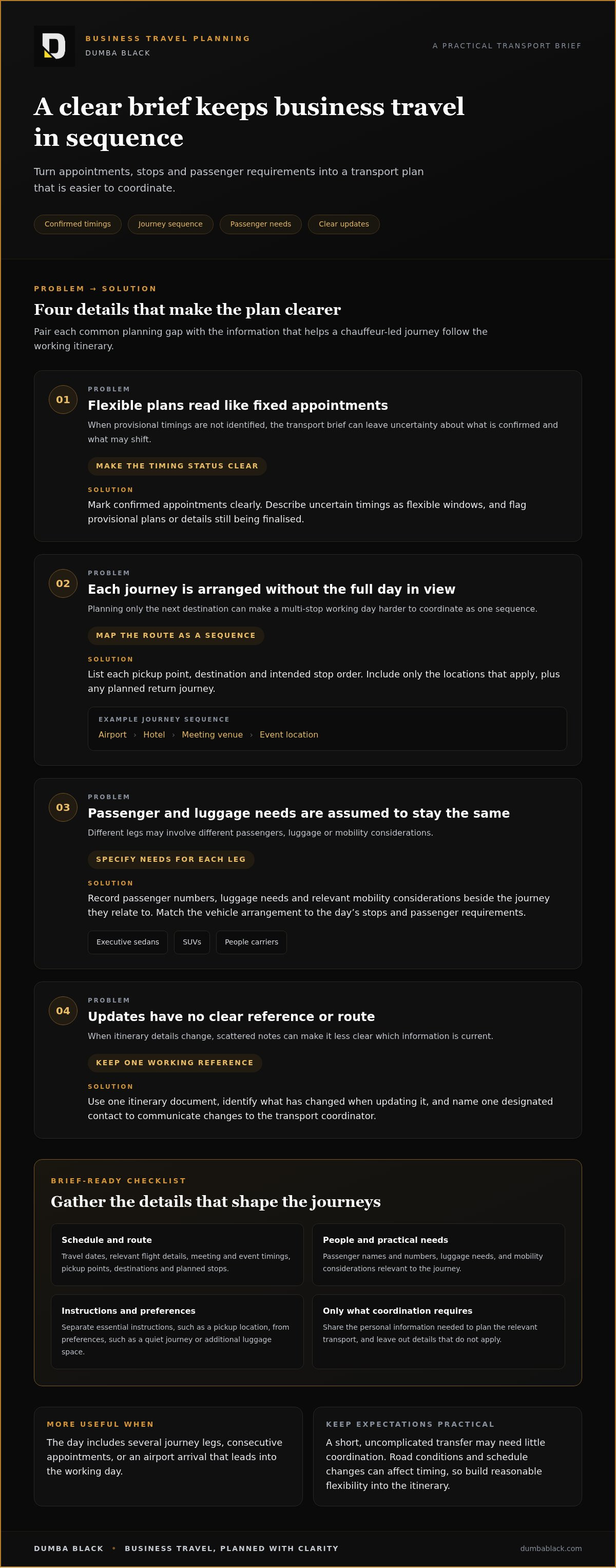
Before arranging a chauffeur service for business travel, turn the working schedule into a clear sequence of journeys. This gives the transport brief a practical foundation and distinguishes fixed appointments from plans that may shift. Include airports, hotels, meeting venues and event stops only when they form part of the itinerary.
A useful transport brief combines the schedule with the passenger details and journey requirements needed to carry it out.
Prepare it in four steps:
- Map the commitments. Gather flight arrival and departure details, meeting start times, event timings and any hotel check-in or check-out points that affect the day. Mark confirmed appointments clearly. Describe uncertain timings as flexible windows rather than fixed commitments.
- Identify each journey leg. List the pickup point, destination and intended order of stops. For example, the itinerary might run from an airport to a hotel, then to a meeting venue and an event location. Leave out stops that do not apply, and note any planned return journey.
- Record passenger requirements. State how many people are travelling on each leg, how much luggage they will carry and any mobility considerations relevant to boarding or the journey. Requirements may differ between transfers, so do not assume the same passengers and luggage apply throughout.
- Share changes and uncertainties. Flag provisional appointments, possible schedule changes and details still being finalised. Provide a designated contact who can communicate itinerary updates, giving revised information a clear route to the transport coordinator.
What itinerary details should be gathered first?
Collect only the information needed to plan the relevant journeys: travel dates, flight details when an airport transfer applies, meeting times, precise pickup points and planned stops. Pair each time with its status, such as confirmed or flexible. Add passenger numbers, luggage needs and mobility considerations beside the journey they relate to. This makes differences between legs easy to see and reduces ambiguity in the brief.
How should an executive assistant prepare the transport brief?
Use one itinerary document as the working reference. Include dates, local times where relevant, passenger names and the journey sequence. Separate essential instructions, such as a pickup location or mobility need, from preferences, such as a quiet journey or additional luggage space. Share only the personal information needed to coordinate transport, and name one designated contact for updates.
Before sending the brief, check that every stop has a clear purpose and that flexible windows are not written as confirmed appointments. If the schedule changes, update the same document and identify what has changed. One concise, current brief is more useful than several versions with conflicting details.
Once the itinerary is organised, discussing corporate chauffeur travel with DUMBA BLACK can help translate its journey requirements into a suitable transport arrangement.
Choose the Right Chauffeur Arrangement for Each Work Journey
The right arrangement depends on the shape of the working day: how many journey legs are involved, whether stops are planned and who needs to travel. For a chauffeur service for business travel, match the booking structure to the itinerary first. Then consider the vehicle in relation to passengers, luggage and the practical requirements of the journey, rather than choosing by status alone.
Use this comparison to identify a suitable starting point:
| Arrangement | Schedule and stops | Coordination needs | Passenger requirements |
|---|---|---|---|
| Single transfer | One clear origin and destination, with a straightforward schedule. | Coordinate the pickup point and destination. | Suited to a defined journey for an individual or travelling party. |
| Multiple scheduled journeys | Several planned legs, such as meetings, an event or other stops. | Share the sequence and identify which timings are fixed or flexible. | Set out who travels on each leg and the luggage requirements. |
| Group movement | Passenger travel linked to a shared schedule or event. | Clarify pickup arrangements, destinations and any separate movements. | Describe the group size and luggage needs so the vehicle choice reflects the journey. |
One transfer, several stops, or a full business schedule?
A direct transfer suits a journey with a clear origin and destination, such as an airport to a hotel. Multiple scheduled journeys can suit a day of meetings, an event or several planned stops. State whether each timing is fixed or may change. This helps the transport plan reflect the working schedule without treating a provisional appointment as settled.
How should vehicle type reflect the traveller's needs?
For an individual or small party with modest luggage, an executive sedan may be a practical fit. An SUV or executive van may better suit different passenger and luggage requirements. Consider how many people travel together on each leg, what they will carry and whether the group stays together throughout the day. DUMBA BLACK’s fleet includes Mercedes-Benz and BMW sedans, Range Rover SUVs and Mercedes-Benz V-Class vehicles.
Passenger numbers can change between journey legs. A vehicle that suits the airport arrival may not suit an event movement involving colleagues or additional luggage. Describe those differences in the brief instead of giving a single passenger figure for the entire itinerary. This helps align the arrangement with actual travel needs.
Prestige may be part of the experience, but it should not replace practical fit. A well-matched vehicle and booking structure make the itinerary easier to coordinate. Ground the decision in the stops, schedule complexity and passenger requirements.
Use This Checklist Before the Business Trip Begins
A final review helps ensure the transport plan reflects the current itinerary, passenger needs and agreed arrangements. Use this checklist before the trip begins, then revisit it whenever a confirmed detail changes. For a chauffeur service for business travel, a concise, current brief is more useful than a long document with conflicting versions.
Itinerary
- Confirm the travel dates and sequence of planned journeys.
- Record each pickup point, destination and relevant meeting or event time.
- Mark timings as confirmed or flexible, and remove stops that no longer apply.
Passenger and vehicle requirements
- Confirm who is travelling on each journey and the passenger count.
- Note luggage requirements and accessibility considerations relevant to boarding or travel.
- State practical vehicle preferences based on the journey, including space needs. Separate essential requirements from preferences such as a quiet journey.
Communication
- Share itinerary updates through the agreed contact rather than sending conflicting versions to several people.
- Provide the designated contact’s details and clarify who is responsible for communicating changes.
- Include only personal information needed to coordinate the transport.
Post-booking review
Review the arranged journeys against the latest schedule. Check that each pickup instruction is clear, every stop appears in the right order, and passenger and luggage needs are reflected accurately. If the itinerary includes multiple movements, compare each leg with the relevant appointment or event, not just the first transfer.
What should be handled when plans change?
Communicate a change promptly through the established contact, so the travel coordinator can pass on one clear update. Label it accurately: distinguish a confirmed schedule change from a possible adjustment that has not been decided. Include what changed, which journey it affects and the revised timing or destination. This makes the update easier to interpret without presenting uncertainty as a final instruction.
For further planning guidance, see this corporate chauffeur service planning guide.
Once your checklist is complete, explore DUMBA BLACK’s corporate chauffeur service for executive transport shaped around your business itinerary.
Arrange Business Travel with DUMBABLACK Chauffeur Support
With the itinerary and transport requirements prepared, shape the arrangement around the work being done. DUMBA BLACK provides corporate and executive chauffeur transport for airport transfers, meeting schedules and business events. A chauffeur service for business travel can be planned around the journey sequence, passenger requirements and practical preferences in your brief.
The aim is a considered transport plan, not a standard arrangement applied to every trip. A direct airport transfer may call for different planning from a day with several appointments or a group travelling to an event. DUMBA BLACK’s chauffeur-driven options include executive sedans, SUVs and vans. VIP Protection is available for journeys where protection is part of the travel requirement. Consider each option in context, without assuming a particular vehicle or service before arrangements are made.
What information helps shape a tailored business journey?
Share the essential details in a clear, current itinerary. This helps shape the transport plan around the stated schedule and purpose while keeping the brief focused on what is useful for coordination.
- Journey sequence: Set out the transfers and stops in order, including the starting point and destination for each leg.
- Dates and timings: Provide the travel dates and identify which appointment times are confirmed and which may change.
- Passenger requirements: State who is travelling on each leg, passenger numbers, luggage needs and any relevant accessibility considerations.
- Preferences and priorities: Note practical preferences, such as a quiet journey, and identify any protection requirements relevant to the trip.
These details help match the vehicle and journey arrangement to the itinerary. A sedan may suit one kind of executive transfer, while passenger numbers or luggage needs may make an SUV or executive van more appropriate. Let the itinerary, not prestige alone, guide the discussion.
Continue planning connected business journeys
If your working itinerary begins with an airport arrival, the guide to private airport transfers in Botswana offers related planning considerations. Keep flight-related transfer details aligned with the wider schedule, particularly if onward meetings or event commitments follow.
For a tailored discussion, share your itinerary with DUMBA BLACK or request a quotation. Include the journey sequence, dates, passenger requirements and relevant preferences so the business transport arrangement can be shaped around the information provided. Explore DUMBA BLACK’s chauffeur services to continue planning your executive travel.
Put Your Business Travel Plan into Motion
A well-prepared journey brief gives your transport arrangement a clear point of reference. Use it to align each transfer with the purpose of the trip, while keeping essential details and preferences easy to distinguish. That is the practical foundation of a chauffeur service for business travel: transport planned around the working itinerary, not added as an afterthought.
DUMBA BLACK’s stated clientele includes corporate and institutional organisations such as UNDP, IFAD, Ericsson Botswana and Stanbic Bank. These names are provided as clientele, not endorsements. DUMBA BLACK provides chauffeur transport for corporate, executive, diplomatic and VIP travel requirements.
When you are ready to put your transport brief into action, share your itinerary and request a tailored arrangement. Share your itinerary with DUMBA BLACK and request a tailored chauffeur arrangement. A considered plan can help you approach the next business journey with greater clarity.
Frequently Asked Questions
What is a chauffeur service for business travel?
A chauffeur service for business travel is pre-arranged, driver-led transport organised to support work commitments. It may cover an airport transfer, a client visit or an event journey. For a travel manager, the key distinction is that transport is planned against the business schedule, rather than leaving each traveller to organise individual rides as needs arise.
Is a chauffeur service useful for a short business trip?
Yes, if a short trip has a specific transport requirement, such as a client appointment immediately after arrival or a change of venue between meetings. Duration alone need not determine whether it is suitable. Consider the journey’s demands, passenger needs and the importance of a defined transport plan. For a straightforward transfer with no additional requirements, a simpler arrangement may be sufficient.
Can a chauffeur take business travellers to several meetings?
Yes. A chauffeur arrangement can be planned around several meeting locations when the journey sequence and expected timings are included in the brief. For example, note whether the same traveller attends each appointment or a colleague joins for one leg. Also state whether the next pickup is at a fixed time or depends on the meeting ending. These details clarify how each movement should be organised.
How should I arrange chauffeur transport for a business itinerary?
Translate the work calendar into transport legs, then align each leg with the relevant appointment or arrival. For a multi-day visit, organise journeys by date so the sequence is easy to follow. Identify who can approve amendments and keep one current version of the itinerary. If people coordinating the trip are in different time zones, state the time zone alongside relevant timings to avoid ambiguity.
What information should an executive assistant provide when booking a chauffeur?
Provide the details that distinguish passengers and make each pickup clear. If colleagues share a transfer, identify the lead passenger and note whether anyone joins or leaves along the way. Include a suitable contact for travel updates and explain how the traveller should be identified at pickup. Keep internal meeting notes and unrelated calendar information out of the transport brief.
Can a chauffeur service accommodate a group travelling for work?
Yes. DUMBA BLACK provides chauffeur-driven transport for group requirements, with executive vans and people carriers among its options. Explain whether the group will travel together, arrive at different times or carry luggage on the same journey. A shared departure may call for a different arrangement from separate transfers for attendees, so describe the group’s movements as well as its passenger numbers.
What should I do if a business meeting changes the travel schedule?
Send the update through the agreed travel contact and identify the journey it affects, not only the revised meeting time. If an appointment runs late, consider whether a later pickup, event arrival or return transfer also needs review. Mark the change as confirmed or provisional, then circulate the current itinerary so the transport coordinator can work from the latest information.


