

A roadshow’s ground plan can determine whether a tightly scheduled day runs smoothly. Corporate roadshow ground transportation management coordinates executive pickups, transfers between meetings, airport journeys, and timing buffers across the itinerary. The goal is a connected sequence of movements, not a series of unrelated rides.
Travel time is only one part of each transfer. Traffic, building access, and the next meeting’s location all affect the schedule. Allow two hours or more between a scheduled landing and the day’s first meeting. This guide explains how ground transportation supports a roadshow, how to structure a multi-stop itinerary, and what details to provide when booking. It also covers vehicle options and practical considerations for planning executive travel with clarity, comfort, and discretion.
Key Takeaways
- Coordinate executive movements across countries by treating each transfer as part of one connected itinerary, with local travel conditions and handoffs considered.
- Build multi-stop schedules around realistic travel windows, building access, traffic and contingency time so meeting plans remain practical.
- Use a clear transportation manifest to keep passenger details, addresses, vehicle assignments and timing notes organised in one place.
- When booking, provide the full itinerary, passenger and luggage needs, flight details, contact information and any privacy or access requirements.
- Match the vehicle to the passenger group and journey, then align airport transfers and corporate travel with the wider roadshow plan.
What Is Roadshow Ground Transportation?
Roadshow ground transportation coordinates executive travel between airports, hotels, offices, and meeting venues. It connects each transfer to the itinerary, so a change in one location can inform the next movement. Effective corporate roadshow ground transportation management brings passengers, pickup details, vehicles, and timing into one working plan. For an international team, the plan must also account for differences between operating locations.
Consider a schedule linking New York, Stamford, and Philadelphia. A Metro-North express train from Grand Central Terminal to Stamford takes about 50 minutes. An Amtrak Acela trip from Penn Station to Philadelphia takes about an hour and a quarter. These rail journeys illustrate how city-to-city travel can fit into a wider itinerary, but they don’t replace planning transfers between stations, hotels, and meeting addresses.
Multi-city operations need a distinct movement plan for each location. A Manhattan pickup involves different access and traffic considerations from a transfer in another city. Record each location’s pickup point, destination, local contact, and scheduled departure, then arrange the sequence around meeting times. This gives executives and coordinators a shared reference for the day.
For example, a New York schedule might include a meeting in Midtown, followed by travel to Jersey City. The Midtown-to-Jersey City PATH trip typically takes 15 to 30 minutes. A Midtown-to-Newark train journey typically takes about 20 to 30 minutes. Those figures describe train travel, not a guaranteed door-to-door journey; the complete plan must include access to the station and onward travel.
Safety, insurance, licensing, and compliance requirements vary by country, city, vehicle, and type of passenger service. Assess the applicable rules for each operating location, including those covering the operator, driver, vehicle, and route, before coordinating cross-border movements.
A multi-city plan should clarify handoffs when local teams or providers change. Use the same itinerary format at every location and record who receives updates when a pickup time or meeting address changes. A central coordinator can relay revised details to the relevant local team, without leaving executives to reconcile separate schedules.
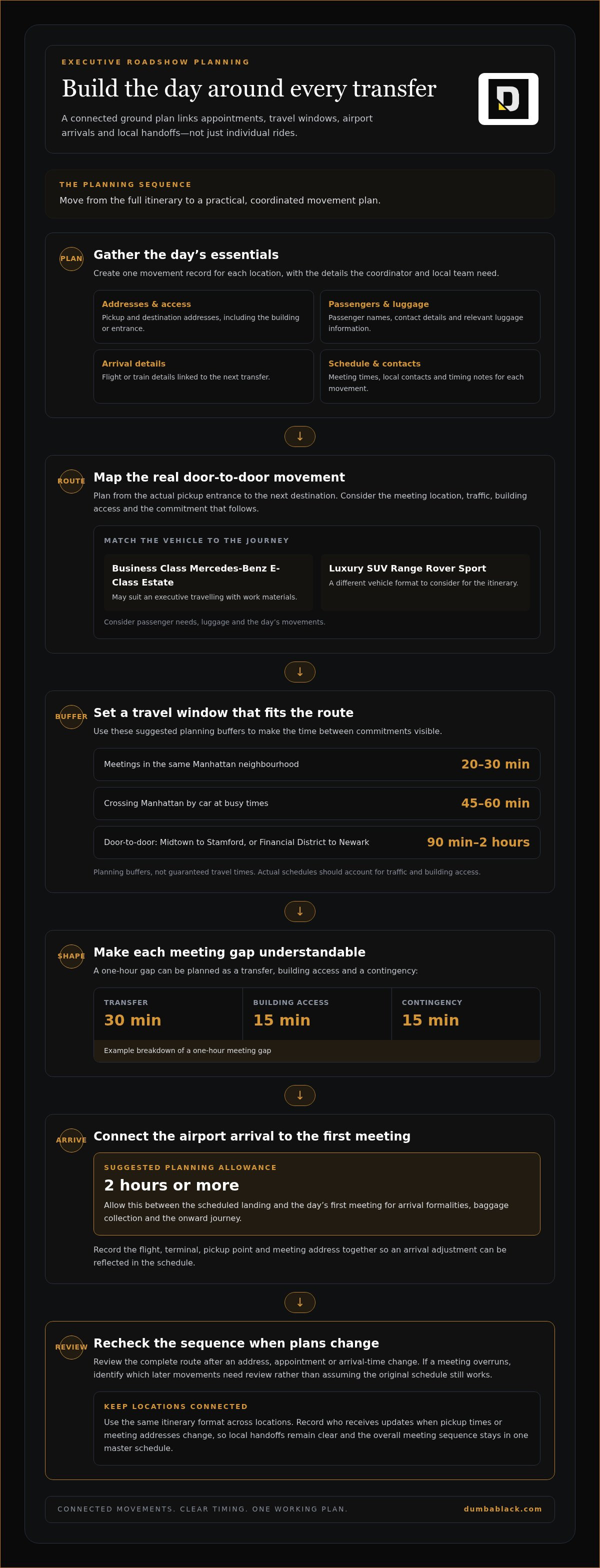
For each location, organise the essentials in one movement record:
- Pickup and destination addresses, including the building or entrance.
- Passenger names, contact details, and relevant luggage information.
- Flight or train arrival details linked to the next transfer.
- Meeting times, local contacts, and timing notes for each movement.
In Botswana, South Africa, Namibia, Zambia, or Zimbabwe, the itinerary should identify where each journey begins and ends. That makes country changes and city handoffs visible before travel starts. It also helps the team distinguish an airport transfer from a meeting-to-meeting movement, keeping the full roadshow sequence legible across locations.
Ground transportation for roadshows and multi-stop itineraries
A workable roadshow itinerary assigns a travel window to every transfer, not just a departure time. Review each meeting address, planned arrival, building access, traffic exposure, and next commitment. Even a short journey by map distance may need extra time during busy periods. Plan for the movement between entrances, not just the distance between neighbourhoods.
Use the location of each meeting to set a practical buffer. For meetings in the same Manhattan neighbourhood, a suggested buffer is 20 to 30 minutes. Crossing Manhattan by car at busy times calls for 45 to 60 minutes. For a door-to-door trip between Midtown and Stamford, or between the Financial District and Newark, allow 90 minutes to two hours. These are planning buffers, not a promise of travel time.
Build the schedule in sequence:
- List every appointment with its building address and scheduled start.
- Map the transfer from the actual pickup entrance to the next destination.
- Add time for traffic, building access, and a contingency before confirming meeting intervals.
- Review the complete route after any address, appointment, or arrival-time change.
A one-hour gap between meetings can be planned as a 30-minute transfer, 15 minutes for building access, and 15 minutes of contingency. This breakdown makes the available time visible. If a meeting overruns, the coordinator can see which later movements require review instead of assuming the original schedule remains feasible.
Airport arrivals need their own transition. Allow two hours or more between a scheduled landing and the day’s first meeting. This gives the schedule room for arrival formalities, baggage collection, and the onward journey. Record the flight, terminal, pickup point, and meeting address together so any arrival adjustment can be reflected in the day’s movements.
Review the order of stops, too. A sequence that repeatedly crosses a city can create avoidable pressure. Compare nearby appointments and group them where meeting commitments allow. For a multi-city itinerary, keep each location’s timing notes and handoff details, while maintaining the overall meeting sequence in one master schedule.
Vehicle choice is part of route planning. A Business Class Mercedes-Benz E-Class Estate may suit an executive travelling with work materials, while a Luxury SUV Range Rover Sport offers a different format for the itinerary. Match the vehicle to passenger needs, luggage, and the day’s movements instead of treating every transfer alike.
For a roadshow that needs coordinated executive journeys, corporate travel arrangements can be considered alongside the itinerary’s route and timing requirements.
Ground transportation program planning
Companies can organise multi-city roadshow transportation by consolidating movements, contacts, and timing notes into one program. A central manifest gives each local team a shared reference for coordinating the itinerary and handling revisions.
Program Planning Approach
Start with a manifest listing pickup times, addresses, stops, vehicles, chauffeurs, passengers, and timing notes. Name a coordinator for each location, along with one person responsible for maintaining the master itinerary. This makes responsibilities clear and gives the team one place to document changes, rather than relying on separate messages or personal calendars.
Next, group the manifest by travel day and location. Show each movement in sequence, from the first pickup to the final drop-off. Put the meeting name beside its address so staff can distinguish a venue entrance from an office mailing address. Keep the same field order throughout. Consistency makes handoffs between teams easier.
Before sharing the manifest, compare it with the latest meeting schedule. Match every passenger to a vehicle and every stop to a time. Flag overlapping assignments, missing addresses, and journeys without a clear pickup point. Reviewing these details can reveal practical gaps before the itinerary reaches executives.
Reliability and Backup Planning
A reliable plan defines what happens when a flight time, meeting address, or vehicle assignment changes. Record how updates are made and who is authorised to revise the manifest. If an appointment moves, for example, the coordinator can update its start time, review the following movements, and notify affected passengers and the local team.
Build contingencies around specific movements rather than adding a general note to “allow extra time.” Identify which later stops depend on each transfer, then name the contact responsible for communicating delays. Keep current passenger and pickup details together so revised instructions do not depend on memory or scattered correspondence.
For each scheduled movement, document the assigned vehicle and chauffeur alongside a designated operational contact. If a disruption requires reassignment, the coordinator can use the manifest to identify affected passengers and stops. Avoid changing one movement in isolation. Review the remaining sequence because a revised pickup may affect later appointments.
Multi-City Roadshow Planning
For a roadshow crossing cities or countries, maintain one master itinerary and a separate movement schedule for each location. Record local addresses, pickup instructions, meeting times, and the responsible contact for every location. A consistent format supports handoffs while letting each local team add relevant arrival or access notes.
Review the sequence whenever the roadshow adds a location or changes an appointment. Check that the preceding arrival connects to the first local movement and that the final stop connects to the next departure. Mark intercity journeys separately from local transfers. This helps coordinators identify schedule changes that could affect the next location.
Before sharing a revised itinerary, confirm that its version date, passenger assignments, and contact details match across the master document and local schedules. Send the same revision to the relevant coordinators. When changes arrive during travel, log the adjustment and affected stops so the next local team can act on current instructions.
Information to provide when booking
A complete booking request lets the coordinator match each movement to the roadshow schedule. Send one itinerary covering every travel date, location, pickup, destination, and appointment. Distinguish an airport pickup from a transfer between a hotel and meeting venue, for example. Include the latest version date so the recipient can identify the current instructions.
For each journey, provide these operational details:
- Passenger names and a designated travel coordinator’s contact details.
- Pickup date, local time, full address, and a recognisable entrance or meeting point.
- Destination address, appointment start time, and any building access instructions.
- Flight number, arrival airport, terminal, and scheduled arrival time for airport journeys.
- Passenger count, luggage needs, and any mobility or seating considerations.
- Vehicle preference, if relevant to the passenger group or work materials.
- Stop sequence, waiting requirements, and the final drop-off location.
- Privacy, security, or communication preferences relevant to the journey.
Clear arrival details matter. A flight number and terminal help distinguish an airport collection from a hotel pickup. For a meeting transfer, name the building and entrance, not just the street. If a passenger carries presentation materials, note the luggage requirement. These details help align the vehicle and pickup instructions with the actual journey.
Booking and approval rules usually come from the organisation’s own travel process. Identify who is authorised to approve the itinerary, the cost centre or project reference, and any required internal booking record. If an assistant submits the request for an executive, include the assistant’s contact details and the passenger’s preferred contact method. This clearly distinguishes the approver, booker, and traveller.
For a multi-city schedule, submit each location’s movements together whenever possible. Mark local time zones, intercity arrival details, and the contact responsible for each location. Separate approved movements from proposed changes. For example, label a revised pickup time as pending approval until the authorised contact accepts it. This helps prevent an informal update from being treated as final.
Keep a simple record of changes. State which journey is changing, the previous detail, the revised detail, and who authorised the update. If a flight arrival shifts, identify the affected pickup and following appointment. Include the date and location with each correction. Coordinators handling several locations need enough context to update the right movement.
Share only the passenger information needed to arrange the trip. Limit sensitive notes to relevant coordinators and use the organisation’s approved communication channel. Before travel, compare the final itinerary with the booking details, including names, addresses, times, and approval status. This helps the roadshow team work from one accurate schedule.
Corporate ground transportation services
For corporate roadshows and investor meetings, choose vehicles according to passenger count, luggage, route, and schedule. Executive sedans suit individual leaders or small parties; larger groups may need SUVs, vans, or coaches. Choose a vehicle that fits the journey, not just a category.
Executive or premium sedans have an indicative capacity of 1-3 passengers. They can suit an investor travelling alone or a small executive party moving between meetings. Executive SUVs are listed at around 3-6 passengers. They may fit a group needing more seating or luggage space, depending on the vehicle and passengers’ requirements.
Passenger vans or executive Sprinters are listed at around 6-14 passengers. Mini-coaches often carry 15-30 passengers, while full-size motorcoaches often carry more than 30. These figures help teams compare broad vehicle formats. They don’t replace matching the actual passenger count, luggage, and itinerary to the selected vehicle.
- One executive: consider a sedan for an individual transfer or investor meeting.
- A small group: assess an SUV against the passenger and luggage needs.
- A larger delegation: compare vans, mini-coaches, or motorcoaches by group size and stop pattern.
Corporate transportation can include airport coordination, point-to-point transfers, and journeys between scheduled meetings. Airport support may include meet-and-greet service and flight-delay monitoring. Connect flight details with the passenger’s pickup point and onward destination so the arrival transfer fits into the same plan as the roadshow appointments.
For investor meetings, privacy and presentation matter alongside seating. A sedan can keep an individual transfer straightforward, while an appropriate larger vehicle may let a group travel together. Consider whether passengers need to work en route, carry presentation materials, or arrive at separate venues. These details shape both vehicle choice and the schedule.
Vehicle type is only one factor in planning executive transportation. Passenger numbers, stops, service duration, airport or fixed-base operator activity, itinerary changes, peak demand, and multi-city complexity can all affect the plan. Build the request around the actual itinerary instead of choosing a vehicle before the movement pattern is clear.
Before confirming a vehicle, match its seating capacity to the passenger list and account for luggage and planned stops. Then decide whether the itinerary needs individual transfers, shared group movements, or both. A mixed plan might assign sedans to individual investor meetings and a larger vehicle to a group transfer, matching each vehicle to its purpose.
DUMBABLACK - The Spirit of Africa: Airport Transfers
DUMBABLACK, The Spirit of Africa, provides Airport Transfers and Corporate Travel for executive itineraries that connect arrivals with meetings and onward journeys. When arranging an airport transfer, share the flight details, passenger names, pickup point, destination, and meeting schedule. This helps align the transfer with the wider roadshow plan.
For an individual executive, a First Class Mercedes-Benz S-Class or BMW 7 Series can suit a private transfer. A First Class+ Mercedes-Benz S-Class LWB offers another executive vehicle option. The appropriate choice depends on the passenger’s itinerary and travel requirements.
For a roadshow that begins or ends in Southern Africa, coordinated airport and corporate transportation can bring separate journey legs into one travel plan. Contact DUMBABLACK, The Spirit of Africa, to discuss your executive transportation requirements.
Set the Next Roadshow in Motion
Turn the itinerary into a practical travel plan, with clear priorities for passengers, meeting movements, and airport connections. Thoughtful corporate roadshow ground transportation management gives your team a framework for coordinating each journey while leaving room to adapt when schedules change.
DUMBABLACK, The Spirit of Africa, provides Airport Transfers and Corporate Travel for executive journeys, alongside Weddings & Events transportation for occasions with different needs. Share your itinerary and travel priorities to start planning a suitable arrangement. Clear details make it easier to align each movement with the purpose of the trip.
For an upcoming roadshow or executive travel requirement, contact DUMBABLACK - The Spirit of Africa to discuss your plans. A well-prepared journey gives your team more space to focus on the meetings ahead, with each transfer considered as part of the wider schedule.
Frequently Asked Questions
How should travel managers compare providers?
Compare written service scopes, booking terms, and reporting processes before considering presentation. Check whether the proposal defines included waiting, itinerary amendments, cancellation terms, and billing records. Ask how changes are documented for finance and travel-policy review. A roadshow involving separate business units, for example, may need invoices or trip records assigned to the correct department. Consistent terms make proposals easier to assess fairly.
Why Not Use Rideshare or Separate Local Cars?
Rideshare can suit an independent journey when passengers can arrange each trip directly. Separate local cars may also work when travellers have unrelated schedules. The trade-off is administration: each booking can create a separate receipt, contact, and record for the travel office. Weigh that paperwork against the simplicity of individual arrangements, particularly when executives need a consistent expense process.
What is corporate roadshow ground transportation management?
Corporate roadshow ground transportation management organises and oversees ground travel for a corporate roadshow. Beyond arranging individual rides, it helps the travel team track responsibility, maintain records, and align transportation decisions with company policy. A travel department may, for example, require each journey to carry a project code and designated approver. These governance details make transport activity easier to review after the trip.
How do corporate roadshow transportation providers compare with rideshare and rental cars?
The key distinction is who handles driving and coordination. With rideshare, passengers arrange separate rides; with a rental car, a traveller is responsible for driving. A chauffeur-driven service provides a driver for planned journeys. Compare options by considering executives’ workload, familiarity with local roads, privacy preferences, and the organisation’s expense process. The right arrangement depends on how much travel responsibility the company wants passengers to carry.
What questions should companies ask when choosing a roadshow transportation provider?
Ask how passenger preferences are recorded and how confidential itinerary details are handled. Clarify which vehicle categories can accommodate the group and its luggage, and how the assigned vehicle suits the journey. Request a clear explanation of booking, billing, and change procedures. To evaluate the process, present a sample itinerary with a late-arriving executive and ask the provider to explain its communication responsibilities.
How are schedules, route changes, and last-minute delays managed during a roadshow?
Distinguish a proposed change from an approved instruction, and ensure the update reaches the people responsible for the affected journey. A calendar edit alone may not notify transportation staff of a revised pickup. If a meeting runs late, the travel lead should decide whether to preserve the next appointment or revise it, then communicate the decision through the agreed channel.
What are the risks and contingency plans for roadshow ground transportation?
Common disruptions include a passenger arriving at the wrong entrance, a venue access restriction, or a meeting running over time. A useful contingency plan identifies who can make decisions and which commitments take priority. A travel manager might, for instance, decide whether an investor presentation or a routine internal meeting takes precedence when a delay affects both. Clear priorities help staff respond consistently.
How can companies manage transportation across multiple US cities and local markets?
Use a common company-wide record while allowing each market to document local operating details. Capture local time zones, airport terminal information, venue entrance instructions, and the appropriate local contact. During a handoff, have the receiving coordinator review these notes rather than relying only on the national schedule. This keeps reporting consistent while recognising that airport layouts and building access procedures differ between locations.


