

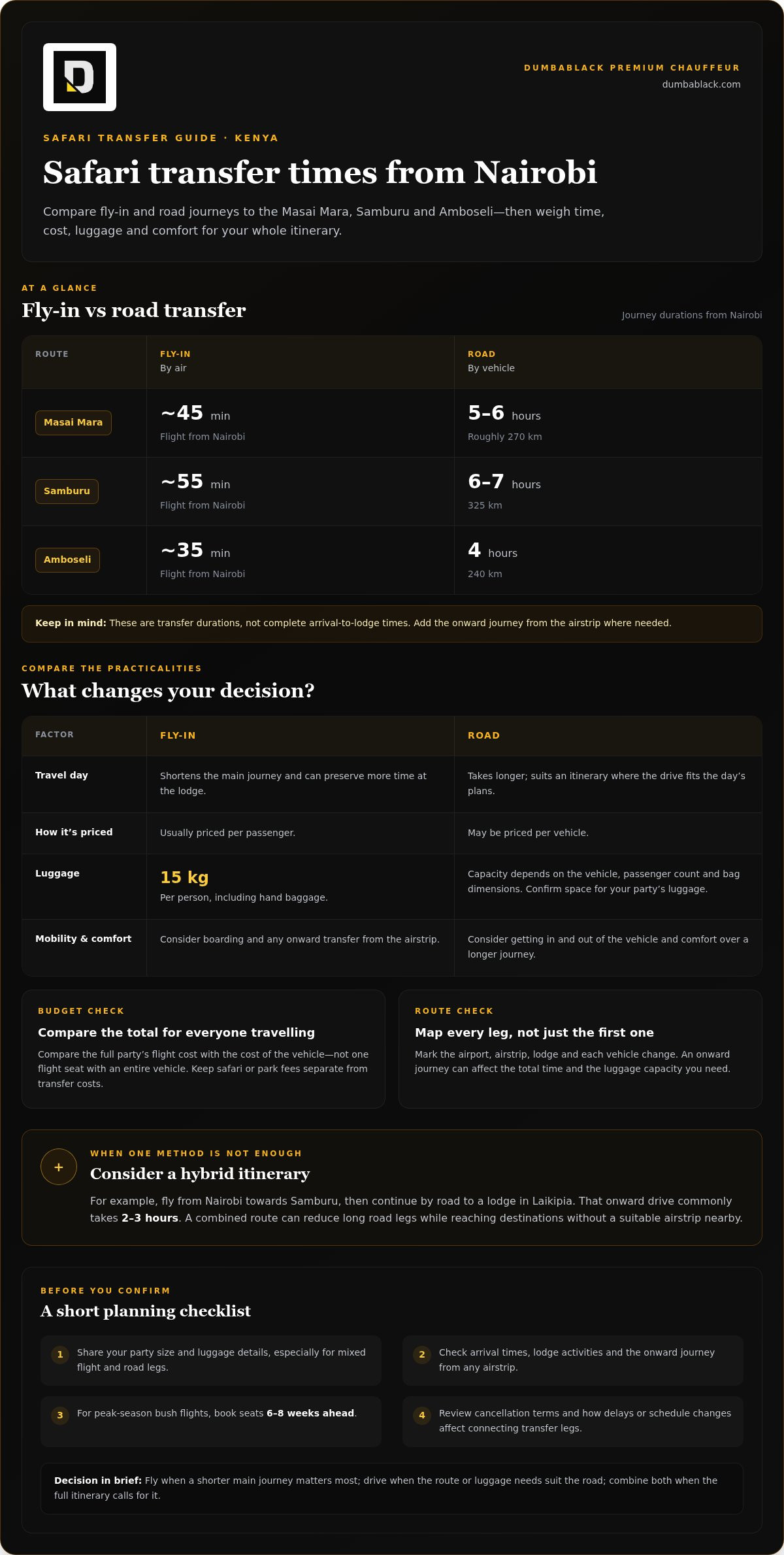
The fastest safari transfer isn’t automatically the best fit. To decide how to choose a safari transfer, weigh journey time, total trip budget, luggage and mobility needs: flying saves time, while driving keeps the journey on the ground. From Nairobi, a flight to the Masai Mara takes about 45 minutes; the road journey covers roughly 270 km and takes 5 to 6 hours.
Both choices can suit a safari, but the right one depends on how you want to spend your travel day and what you need to carry. Bush flights have a 15kg luggage limit per person, including hand baggage, which can affect travelers with substantial or specialised luggage. Cost comparisons also depend on whether the transfer is priced per passenger or per vehicle, and how many people are travelling. This guide compares fly-in and road transfers for time, cost and mobility, with practical examples for Kenya’s Masai Mara, Samburu and Amboseli routes. You’ll be able to identify which option best fits your itinerary and priorities.
Key Takeaways
- Choose a fly-in transfer when preserving time at the lodge matters most; choose the road when the drive itself fits your itinerary.
- Compare how each option is charged: flight costs are typically per passenger, while road transfers may be priced per vehicle. Group size can change which feels better value.
- Consider a hybrid itinerary when one transfer method does not suit every leg of the safari.
- For private or shared travel, weigh the value of a dedicated schedule and greater privacy against the practicalities of travelling with others.
- Before deciding, account for luggage, mobility needs, arrival times and the amount of time you want to spend in transit.
Choosing transfers based on trip length, budget, and mobility
Start with the travel day, not the aircraft or vehicle. A Nairobi-to-Masai-Mara flight takes about 45 minutes; driving covers roughly 270 km and takes 5 to 6 hours. The flight preserves more time at the destination, while the road journey occupies a larger part of the day. Compare those timings with your arrival schedule and planned lodge activities.
Budget depends on how the transfer is priced and who is travelling. Bush-flight fares are generally calculated per passenger, while road transfers may be priced per vehicle. A solo traveller and a group may therefore assess the options differently. Compare the total for everyone travelling, rather than one flight seat with the cost of a whole vehicle. Keep safari or park fees separate from the transfer cost.
Luggage can also affect the decision. Bush flights have a 15kg-per-person limit, including hand baggage. That matters if you carry specialist equipment, several bags, or items needed during a longer stay. A road transfer may suit travellers with more luggage, but the vehicle’s capacity and the group’s belongings still need to be considered together. For mobility needs, consider boarding, getting in and out, and comfort during a longer journey.
| Option | Journey time | Budget comparison | Luggage and mobility |
|---|---|---|---|
| Fly to the Masai Mara | About 45 minutes from Nairobi | Usually priced per passenger | 15kg luggage limit per person, including hand baggage |
| Drive to the Masai Mara | 5 to 6 hours across roughly 270 km | May be priced per vehicle | Consider vehicle capacity and comfort over the longer journey |
| Fly to Samburu | About 55 minutes from Nairobi | Usually priced per passenger | Apply the bush-flight luggage limit |
| Drive to Samburu | 6 to 7 hours across 325 km | May be priced per vehicle | Plan for an extended time on the road |
Use a simple sequence to decide. First, consider how much time you can spend travelling. Next, compare the total transfer cost for your party using the correct pricing basis. Then account for luggage and any difficulty with boarding or sitting for extended periods. A traveller with limited time and compact luggage, for example, may prefer a flight to the Masai Mara, while a group with more bags may favour a road itinerary. These are practical trade-offs, not universal rules.
For a shorter onward journey, Amboseli offers another comparison: about 35 minutes by air, or 4 hours by road across 240 km from Nairobi. Choose the option that best balances time, total party cost, and physical comfort across the full itinerary.
Fly-In vs Road Transfer Safari: Which Should You Pick?
Combine a flight and a road transfer when one method cannot take you conveniently to every lodge. For example, fly from Nairobi towards Samburu, then continue by road to a lodge in Laikipia. That onward drive commonly takes 2 to 3 hours. The hybrid approach can reduce long road legs while preserving access to destinations without a suitable airstrip nearby.
When comparing safari transfer companies, look for reviews covering the same route, vehicle type, and travel conditions you need. Seek consistent details about communication, punctuality, luggage handling, and how disruptions were managed. A review of a short airport journey may reveal little about a long transfer between parks.
Before booking, ask about the safety procedures for the vehicle and journey, and review the passenger insurance terms. Check that the transfer plan identifies the vehicle and explains how driver and passenger arrangements are managed. These details matter for road travel as well as airport collection.
For bush flights, the stated luggage limit is 15kg per person, including hand baggage. Road vehicles don’t share one universal luggage allowance: usable space depends on the vehicle, passenger count, and bag dimensions. Give the operator your party size and luggage details before finalising a mixed itinerary, especially when separate flight and road legs have different capacity limits.
Park entry rules, border crossings, and permits can affect the route and timing. Identify every country and protected area on your itinerary, then establish which entry points and documents apply. A transfer crossing a border may require a different route plan from a journey within one country.
Book peak-season bush-flight seats 6 to 8 weeks ahead. Before paying, read the cancellation terms and understand how schedule changes, missed connections, or flight delays affect the remaining transfer legs. Keep flight arrival details and lodge collection arrangements aligned, so a change to one segment doesn’t leave the next leg unclear.
From Nairobi, flights take about 45 minutes to the Masai Mara, 55 minutes to Samburu, and about 35 minutes to Amboseli. Road journeys take 5 to 6 hours to the Masai Mara, 6 to 7 hours to Samburu, and 4 hours to Amboseli. These are transfer durations, not complete arrival-to-lodge times; add the onward journey from the airstrip where needed.
Choose a fly-in transfer when a shorter main journey matters, a road transfer when it better suits the route or luggage, and a hybrid itinerary when the destination requires both. Compare the complete sequence of legs, not just the first departure.
Fly-in and road-transfer options
Knowing how to choose a safari transfer starts with mapping the complete route. Mark the airport, any regional airstrip, the lodge, and each change of vehicle. This shows where flying can shorten a leg and where road travel is still needed. On a Kenya itinerary, for instance, the final stretch from an airstrip to a lodge may require a vehicle.
A fly-in leg works best when the arrival airstrip connects smoothly with the next part of the itinerary. Check how passengers and bags get from the aircraft to the onward vehicle, and whether lodge collection aligns with the arrival plan. A flight is one segment, not necessarily a door-to-door journey. Include the ground connection in the arrangements.
Road transfers can connect an airport, lodge, or separate safari areas without adding an air connection. They may also suit itineraries with several stops, where a vehicle can continue along the planned route. For example, a journey between Samburu and Laikipia could include a road leg as part of a broader safari plan.
- Flight only: Select this when an airstrip is suitably placed for your destination and onward arrangements are clear.
- Road only: Use this when the route is direct or includes stops that fit a ground journey.
- Flight and road: Combine both when air travel reaches the area, but a vehicle is required for the lodge connection.
- Road between safari areas: Choose this when your itinerary links locations more naturally by vehicle.
For a hybrid itinerary, assign one person to coordinate the flight arrival, airstrip collection, and lodge handover. Share the same passenger and luggage details for each leg. If the flight schedule changes, update the onward vehicle plan to reflect the revised arrival. A connected itinerary helps each part of the journey work as one sequence.
If you’re deciding how to choose a safari transfer, compare the full sequence, not just the first departure. List each pickup, handover, and final drop-off. Then note where the vehicle changes and what information the next driver needs. This is especially useful when the international arrival, domestic flight, and lodge collection are arranged separately.
The outbound and return journeys may need different arrangements. One direction could connect conveniently by air, while the return may suit a road transfer and another stop. Review each direction separately, noting the arrival point, onward journey, luggage arrangements, and lodge schedule before finalising the itinerary.
Bush planes used for Kenya safari transfers are usually 12 to 14-seat Cessna Caravans, so confirm how passenger and luggage arrangements fit the aircraft before coordinating the onward vehicle.
How do I choose between a private and shared safari transfer?
A private transfer is reserved for your party; a shared transfer carries passengers travelling on a compatible route. The choice affects privacy, scheduling, and how the journey accommodates your group. A couple heading directly to one lodge, for example, may value a vehicle dedicated to their plans. A solo traveller may prefer sharing if the route and timing work.
Choose private travel when control over collection and stops matters. Your party can coordinate the transfer around its flight arrival, lodge plans, or onward connection. This may suit families with children, travellers with mobility considerations, or guests carrying equipment that needs careful placement. A private vehicle also lets colleagues or companions travel together without sharing the cabin with other guests.
A shared transfer may suit travellers with flexible plans whose destination matches the scheduled route. Collection or drop-off may need to be coordinated with other passengers, and the journey can include additional stops. Someone staying at a lodge on the shared route, for example, may accept a longer door-to-door journey in exchange for sharing the transfer. Compare the complete travel plan, not just the vehicle category.
Before deciding, work through these practical checks:
- Match the route: Compare each pickup and drop-off with your airport, lodge, and any planned connections.
- Consider your schedule: A private arrangement may suit a tight arrival sequence; a shared journey needs flexibility around other passengers.
- Assess privacy: Choose a private vehicle for confidential conversations or a quiet journey with your own party.
- Review luggage needs: A family travelling with several bags should consider passenger space and storage together.
- Account for mobility: Discuss boarding assistance, vehicle access, and rest stops as relevant to your party.
For a corporate group arriving in Nairobi and continuing to a lodge, a private transfer can keep colleagues together and simplify coordination. A solo guest joining a safari itinerary may find a shared option more practical if pickup times and destinations align. Neither arrangement is automatically better; the route, passenger mix, luggage, and schedule determine the better fit.
Compare written itineraries carefully. Confirm whether the arrangement is private or shared, where collection occurs, which stops are planned, and how the lodge handover works. For a shared journey, clarify how other pickups affect the route. For a private journey, ensure the vehicle plan suits your party’s luggage and access needs. These details help you compare equivalent options before choosing.
Choose private travel for greater control, discretion, or a schedule tailored to your party. Choose shared travel when route compatibility and flexibility matter more. If a journey includes an airport, lodge, and onward connection, assess each transfer leg separately rather than assuming one arrangement suits the entire safari.
How much do safari transfers typically cost by vehicle type and destination?
Safari transfer costs depend on the route, vehicle, and pricing basis. A flight is commonly priced per passenger, while a road transfer may be priced per vehicle. Compare the total for your party, not the cost of one seat with that of an entire vehicle. The number of passengers can affect which option offers better value.
The destination also affects the calculation. A Nairobi-to-Masai-Mara transfer differs from a Nairobi-to-Samburu journey because the route, distance, and available transfer arrangements differ. For a fly-in itinerary, include each passenger’s flight and any required onward road leg. Assess a road itinerary as a complete journey to the destination, not just its first segment.
Vehicle type affects the arrangements for a road transfer. The suitable vehicle depends on passenger numbers, luggage, mobility needs, and the route. A small party travelling with substantial luggage, for example, may need a different arrangement from a solo passenger with one compact bag. Ask for the total journey cost based on your party and itinerary.
To compare equivalent quotes, set out these details before reviewing them:
- Route: Name the airport, park or safari area, lodge, and any intermediate stops.
- Party: State how many passengers are travelling and whether the transfer is private or shared.
- Luggage: Include bag quantities and any items that need additional space.
- Transfer format: Identify whether you’re comparing a flight, road journey, or combination of both.
- Collection plan: Include the arrival point and final drop-off, so connections aren’t omitted.
For example, a group comparing a Nairobi-to-Amboseli road transfer with flights should include every passenger’s flight and the ground connection to the lodge. A vehicle quote may cover the whole party, while flight costs are calculated per traveller. The totals are not comparable until each quote covers the same endpoints and transfer legs.
Ask for a written quotation identifying the route, vehicle arrangement, passenger basis, and included transfer legs. The total depends on the journey; route, vehicle type, passenger count, and itinerary all affect the price. This helps prevent a lower initial figure from seeming more comprehensive than it is.
For a safari journey that includes airport collection and a lodge connection, request a tailored Safari & Lodge Transfers quotation with your route and passenger details. Compare the resulting itinerary against other options using the same destinations and transfer requirements.
DUMBABLACK - The Spirit of Africa: Airport Transfers
DUMBABLACK, The Spirit of Africa, provides airport transfers for travellers connecting from an airport to a hotel, lodge, or onward safari journey. If your itinerary includes an airport arrival and a lodge transfer, coordinating both legs can help keep the travel plan clear and connected.
DUMBABLACK’s Safari & Lodge Transfers suit journeys that continue beyond the airport to a safari stay. Share your arrival details, destination, passenger needs, and luggage information when arranging the journey. This gives the transfer plan practical context, whether you’re travelling privately or coordinating transport for corporate guests.
If your safari itinerary begins with an airport pickup, contact DUMBABLACK, The Spirit of Africa, to discuss your transfer, or visit dumbablack.com.
Make your next safari connection part of the plan
Knowing how to choose a safari transfer comes down to matching the journey to the arrival experience you want. Consider what would make the next leg feel orderly: a coordinated pickup, a clear handover, or transport that connects smoothly with a wider itinerary. Share those priorities when arranging your travel, especially if the safari is part of a business programme or special event.
DUMBABLACK, The Spirit of Africa, offers airport transfers, corporate travel, and weddings and events transport. Its team can coordinate ground transport around your travel plans, including the connection between an airport and a safari stay. A considered plan gives you a clearer starting point for the journey ahead.
Contact DUMBABLACK - The Spirit of Africa to discuss your itinerary and transportation needs. Contact DUMBABLACK - The Spirit of Africa and take the next step towards a safari journey arranged around your priorities.
Frequently Asked Questions
What types of safari transfers are available, such as road, air, and shared shuttle?
Common options include private road transfers, bush flights, shared shuttles, and itineraries combining air and road travel. A private vehicle suits travellers who value a dedicated schedule; a shared shuttle follows a route planned for multiple passengers. Flights can shorten travel between regions, while a vehicle may still be needed between an airstrip and lodge. Compare each leg separately, including collection points and onward connections.
Are safari transfer vehicles suitable for luggage, children, and travelers with mobility needs?
Suitability depends on passenger space, luggage volume, and the assistance each traveller needs. Before arranging transport, note bag dimensions, strollers, mobility aids, and whether anyone finds high steps or prolonged sitting difficult. For a family with young children, include their ages and any seating requirements in the journey plan. A clear passenger profile helps match the vehicle and transfer arrangements to the group’s practical needs.
How do I arrange airport pickup and coordinate a transfer with my safari itinerary?
Provide your flight details, arrival time, passenger names, luggage information, and the lodge’s exact name and location. Then map the journey from airport collection through any connecting flight or road leg to the lodge. If a domestic flight follows an international arrival, for example, account for the terminal change and handover. Keep the travel details consistent across each transfer arrangement.
What safety standards and insurance should I verify before booking a safari transfer?
Ask about the safety procedures for the vehicle and journey, and review the passenger insurance terms. Check that the transfer plan identifies the vehicle and explains how driver and passenger arrangements are managed.


