

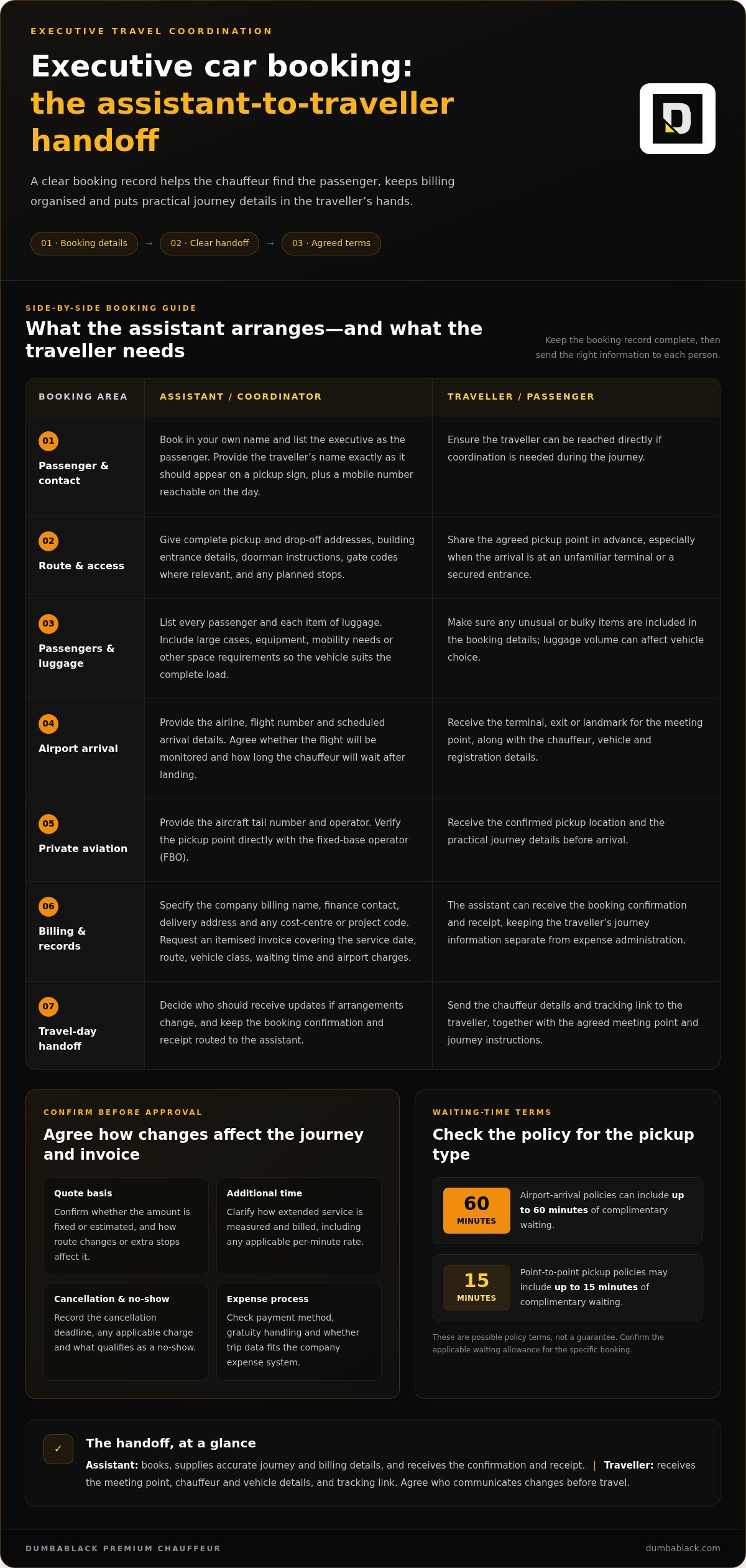
An executive assistant car service booking checklist should cover the traveller’s name, reachable mobile number, passenger and luggage counts, pickup and drop-off addresses, and access instructions. For airport travel, include the airline and flight number. For private aviation, provide the aircraft tail number and operator, and confirm the pickup point with the fixed-base operator. You can book in your own name, list the executive as the passenger, and have the confirmation and receipt sent to you while the chauffeur details and tracking link go to the traveller.
A smooth journey takes more than choosing a vehicle. Clear instructions help the chauffeur find the passenger, agreed billing details simplify expense reporting, and a contingency plan keeps the right people informed if arrangements change.
This guide covers the details to provide when booking, how to organise invoices and receipts, and the safety and backup arrangements to settle before travel. It also explains how to plan roadshows and multi-stop itineraries, where an ordered route and realistic drive times help keep the day on track.
Key Takeaways
- Share the passenger’s name and day-of-travel mobile number, complete addresses, access instructions, luggage count, and relevant flight details.
- Agree on invoice requirements in advance, including itemised trip charges and any cost-centre details needed for expense reporting.
- Set clear expectations for passenger-information handling, chauffeur screening, location updates, and contingency communication.
- Keep the booking confirmation and receipt routed to the assistant while ensuring the traveller receives the practical journey details.
- Use an ordered itinerary and realistic drive-time estimates to bring structure to roadshows and multi-stop journeys.
What information should an executive assistant provide to a chauffeur service?
Start with the passenger’s identity, journey details, and arrival plan. Provide the traveller’s name exactly as it should appear on a pickup sign, along with a mobile number the chauffeur can reach on the day. Add pickup and drop-off addresses, the building entrance, doorman instructions, and gate code. These details distinguish a main entrance from a private or secured arrival point.
For airport arrivals, provide the airline, flight number, and scheduled arrival details. Before the first ride, establish whether the flight will be monitored and how long the chauffeur will wait after landing. Agree how you and the traveller will receive the chauffeur, vehicle, and registration details. A passenger arriving at an unfamiliar terminal should know the meeting point in advance.
- Provide passenger and contact details. The traveller’s name and day-of mobile number help identify the passenger and support direct coordination.
- List every passenger and each item of luggage. Luggage count can influence vehicle selection more than passenger count, especially with large cases or equipment.
- Match the vehicle to the complete load. Include passenger numbers, luggage, and any mobility or space needs so the vehicle suits the journey.
- Send the airline and flight number. These details allow flight monitoring and help the pickup plan account for arrival changes.
- Specify the exact airport meeting point. Name the terminal, exit, or agreed landmark, and include an access instruction such as a gate code where relevant.
- Coordinate private aviation pickups with the FBO. Verify the pickup point directly with the fixed-base operator, then provide the aircraft tail number and operator.
- Record cancellation, waiting, and no-show terms. Airport arrival policies can include up to 60 minutes of complimentary waiting; point-to-point pickups may include up to 15 minutes. Note the cancellation deadline, any applicable charge, and what qualifies as a no-show.
Choose a vehicle to suit both the passenger count and luggage volume. An executive travelling alone with several large cases may need more space than a group travelling light. Include unusual items, such as presentation materials or mobility equipment, in the booking details. Clear information about the load helps match the vehicle to the journey.
For airport journeys, provide the full destination address and any planned stops. The price depends on the journey and is provided after a quote request. Route, vehicle class, waiting, and airport charges affect the amount. Listing the route in advance helps distinguish a direct transfer from one with additional stops.
Billing, expense reporting, and policy compliance
Before authorising a journey, align the booking record with your company’s expense process. Request an itemised invoice showing the service date, route, vehicle class, waiting time, and airport charges. These details help finance match the charge to the traveller and business purpose without relying on a vague transaction description.
Clarify how the quoted amount is calculated. Ask whether it is fixed or estimated, and how itinerary changes affect the final invoice. If a journey runs beyond its scheduled time, establish how additional time is billed. Written terms should explain any applicable per-minute rate and how the extra time is recorded.
- Request an itemised invoice. Separate waiting, parking, and airport charges so each expense can be reviewed and coded correctly.
- Specify the invoice recipient. Provide the company’s billing name, finance contact, and delivery address so the document reaches the right team.
- Include a cost centre or project code. Ask for the required reference to appear on the invoice, helping finance assign the journey to the correct department or event.
- Confirm the billing basis. Establish whether the quote is fixed or estimated, and how route changes, additional stops, or extended service affect the final charge.
- Clarify additional-time charges. Ask how overtime is measured and billed, including whether the invoice records actual extra minutes at the applicable per-minute rate.
- Check expense-system compatibility. Ask whether trip data can be exported in a format accepted by the company’s travel and expense system.
- Record the approved payment method. Follow internal policy for purchase orders, card use, or account billing, and keep the booking confirmation with the expense record.
- Agree how gratuity is handled. Clarify whether it is included in the quoted amount or appears separately, so employees follow the organisation’s reimbursement policy.
For policy compliance, keep the booking details consistent across the confirmation, invoice, and expense submission. A route described as “airport to office” may not explain a client visit or site transfer. Add the business purpose or project reference through your company’s approved expense process. Limit passenger details to what dispatch and finance need, and store receipts in the authorised system.
Before approval, compare the invoice terms with your company’s travel policy. Check who can authorise itinerary changes, which cost centre applies, and how to submit receipts. A prepared billing record reduces follow-up between the assistant, traveller, and finance team after the journey.
Executive safety and contingency planning
Set safety expectations before sharing an executive’s itinerary. Request evidence of active commercial liability insurance and confirm that its limits suit executive transport. Review the provider’s screening process, including background checks and driving records. These checks clarify who may transport the passenger and what protections apply during the journey.
Set clear privacy boundaries, too. Ask whether passenger details are shared beyond the dispatch team and identify which trip information is necessary. Share only operational details, such as pickup instructions and a day-of contact. Avoid circulating sensitive schedules broadly. The Federal Trade Commission’s business cybersecurity guidance recommends retaining only needed data, limiting access, protecting sensitive information, disposing of it securely, and preparing for incidents.
- Confirm insurance and screening. Record whether commercial liability coverage is active, whether its limits fit executive transport, and whether screening includes background checks and a clean driving record.
- Set passenger-information boundaries. Establish whether itinerary details are shared outside dispatch, who can access them, and how unnecessary records are securely disposed of.
- Agree on location updates. Before the first ride, ask whether the assistant can view the vehicle’s location without calling. If a tracking link is provided, forward it to the traveller and keep it open to monitor arrival.
- Name the escalation contacts. Give the traveller and assistant a clear contact route for delays, missed connections, changed pickup points, or vehicle issues.
- Write down the contingency sequence. Specify who contacts the chauffeur, who informs the executive, and who approves a revised route or replacement arrangement.
- Plan handoffs separately. For air travel, assign responsibility across airline, airport, ground vehicle, hotel, rail station, and destination connections. The U.S. Department of Transportation explains airline assistance duties; other handoffs need separate coordination.
For disruptions, give the assistant one concise action plan rather than several competing message threads. Keep the booking reference, pickup details, passenger contact, and escalation route together. If a flight changes, update the ground journey and notify the traveller through the agreed channel. For a roadshow, identify the next scheduled stop and who can approve a revised sequence.
Safety planning should respect the executive’s preferences. Record whether the passenger wants direct chauffeur contact or coordination through the assistant. Limit access to the itinerary and share only the information each person needs. A consistent protocol supports discretion and keeps decisions clear during disruptions.
Receipt and company account details
Choose the account structure before the first executive journey. A business account can consolidate rides on one monthly invoice or invoice each executive’s rides separately. The right arrangement depends on how the organisation assigns travel costs and reviews expenses. For example, a central travel team may prefer consolidated billing, while separate departments may need individual executive records.
Fit the account to your company’s internal workflow. Identify who can place bookings, who receives confirmations, and who reviews receipts. Keep those roles distinct when assistants arrange transport for several executives. A shared account contact can manage administration while each traveller’s journey remains identifiable in company records.
- Select consolidated billing. Use one monthly invoice when finance reviews transport spending centrally and reconciles multiple journeys together.
- Select separate executive invoices. Use individual invoices when each executive’s travel must be reviewed or allocated independently.
- Name the account administrator. Assign a specific finance or travel contact to manage billing queries and account records.
- Set receipt routing. Decide whether receipts go to the booking assistant, traveller, finance team, or more than one authorised recipient.
- Define the record label. Use a consistent executive name or internal reference so finance can distinguish similar journeys.
- Keep booking and receipt records together. Store the confirmation and final receipt in the same approved expense file or system.
- Establish a review route. Decide who checks submitted receipts and who resolves discrepancies before expenses are closed.
Receipt routing matters when an assistant books for an executive. The assistant may need the receipt for administration, while the traveller needs journey details. Decide who receives each document and use the same process for repeat bookings. For example, finance should not have to search personal inboxes for an executive’s travel receipt.
For a company account, distinguish clearly between the person arranging the ride and the person whose travel it records. The booking assistant, passenger, and invoice recipient may be different people. Record each role consistently, especially for visiting executives or guests whose costs belong to a specific department.
Review the account setup after the first billing cycle. Compare the invoice structure with your organisation’s reconciliation process. If finance needs journeys grouped by executive, a consolidated invoice can work when its records clearly identify each passenger. If separate approval paths apply, individual invoices may be more practical. Align the arrangement with company policy before the next booking.
Booking as an assistant for an executive
An assistant can book in their own name and list the executive as the passenger. The confirmation and receipt can go to the assistant, while chauffeur details and the tracking link go to the traveller. Use the executive assistant car service booking checklist to manage these separate responsibilities, not just to record passenger details.
Confirm the booking in writing against the itinerary before sharing trip information. Check the date, pickup time, addresses, passenger name, and route against the executive’s approved schedule. Then send the traveller the meeting point, chauffeur contact details, and tracking link. Give the chauffeur operational instructions through the booking channel, including access details and the passenger’s preferred communication method.
- Use the assistant’s booking contact. Enter your name and contact details as organiser, then identify the executive as passenger.
- Match the confirmation to the schedule. Check the pickup time, addresses, planned stops, and passenger details against the latest approved itinerary.
- Route information by role. Send the executive journey details and tracking information; retain the receipt and booking record for administration.
- Arrange standard corporate journeys ahead. Book 12 to 24 hours before travel when possible.
- Allow more planning time for complex trips. Arrange roadshows, group transfers, and multi-stop journeys a few days in advance.
- Order roadshow stops clearly. Map destinations in sequence and estimate realistic drive times between appointments.
- Plan for the largest passenger group. For a roadshow, select the vehicle according to the day’s highest passenger count, not the first stop.
- Clarify the quoted amount. Establish whether the price is fixed or estimated, and how itinerary changes affect it.
A roadshow needs more than a list of addresses. Put the morning meeting, client visit, and afternoon venue in travel order. Note the expected passenger count at each stop, then plan for the largest group. This gives the booking team a clear basis for vehicle selection and avoids planning only for the first pickup.
Assign one person to manage itinerary changes. If a meeting moves, update the booking and notify the executive through the agreed channel. Keep the current itinerary separate from earlier versions so the passenger and chauffeur receive consistent instructions. A concise change notice should state the revised stop, timing, and affected contact.
Use the executive assistant car service booking checklist as a shared handover record if a colleague may need to manage the journey. Include the booking reference, current itinerary version, communication roles, and any pending decision. This lets a colleague continue coordinating without relying on scattered messages or assumptions.
For a coordinated executive journey, arrange corporate transportation with the itinerary, passenger details, and communication roles ready.
DUMBABLACK - The Spirit of Africa: Airport Transfers
DUMBABLACK - The Spirit of Africa provides airport transfers for executives who need their arrival and onward journey coordinated with care. Share the itinerary, passenger requirements, and preferred communication route so transfer arrangements fit the executive’s schedule. For recurring business journeys, Corporate Travel can provide a more coordinated approach. Weddings & Events and Safari & Lodge Transfers support event travel and lodge connections.
For an airport booking, prepare the flight details, luggage count, destination, and meeting-point instructions. These details help coordinate the transfer with the passenger’s plans.
Contact DUMBABLACK - The Spirit of Africa or visit dumbablack.com to discuss an airport transfer.
1 Social media: DUMBABLACK - The Spirit of Africa’s official social media channels.
Make the next journey easier to coordinate
Make the executive assistant car service booking checklist a working document, and refine it after each journey. Note which handoffs were clear, where information had to be repeated, and what would make the next itinerary easier to manage. A consistent process helps new assistants maintain the same standard of preparation.
Keep the document practical. Assign responsibility for booking updates, passenger communication, and internal expense records. Review it when travel patterns change, such as a new destination, roadshow format, or executive preference. This makes each booking part of the organisation’s wider travel practice rather than an isolated task.
For your next executive journey, bring the itinerary and coordination requirements together before arranging transport. Contact DUMBABLACK - The Spirit of Africa to discuss your travel arrangements. With a considered process in place, you can approach each journey with greater clarity and confidence.
Frequently Asked Questions
Can one person book for several executives?
Yes. One assistant can coordinate bookings for several executives, provided each journey has its own passenger details and itinerary. For example, keep separate records for an executive arriving on a morning flight and another travelling to a meeting later that day. Distinct booking references and clearly assigned contacts help prevent schedule changes or receipts being attributed to the wrong traveller.
How do professional chauffeur services handle flight delays and real-time changes?
Flight monitoring can help coordinate an airport pickup when the arrival time changes. For other changes, such as a revised destination or meeting time, send an update through the agreed booking channel and identify the affected journey. The assistant should also tell the traveller what has changed and who will provide the next update, rather than relying on multiple informal messages.
How far in advance should an executive assistant book corporate transportation?
For standard corporate journeys, arrange transportation 12 to 24 hours before travel. Roadshows, group transfers, and multi-stop itineraries benefit from booking a few days ahead. That additional planning time lets the assistant organise the stop sequence, estimate drive times, and align the vehicle with the day’s largest passenger group. For a last-minute change, send the revised itinerary and booking reference together.
How should accessibility be included in a booking?
Describe the passenger’s practical needs clearly, such as space for a mobility aid, help entering or leaving the vehicle, or a pickup point with minimal walking. Include relevant chauffeur instructions and the best way to communicate with the traveller. Avoid sharing unnecessary medical details. Clear, task-focused information helps address access needs discreetly in the journey plan.
How should recurring traveler preferences be stored?
Keep recurring preferences in an access-controlled travel profile or the organisation’s approved booking system. Record useful details, such as the preferred communication method, usual pickup instructions, and vehicle needs, rather than storing full itineraries indefinitely. Limit access to travel coordinators, update details when preferences change, and remove outdated information securely. This supports consistent service without unnecessarily circulating personal data.
What Detailed Drivers waiting policy applies?
The stated terms allow 45 minutes of complimentary waiting for domestic airport pickups, starting at actual landing, and 60 minutes for international airport pickups, also starting at actual landing. Non-airport pickups include 15 minutes of complimentary waiting. Before booking, distinguish airport waiting from point-to-point waiting, and note how the applicable period begins so the traveller and assistant share the same expectation.
What details should an executive assistant collect before booking car service?
Collect the passenger’s name, day-of contact number, pickup and destination addresses, access instructions, passenger and luggage counts, and journey schedule. Airport bookings also need the airline and flight number. For private aviation, provide the aircraft tail number and operator, and confirm the pickup location with the fixed-base operator. A roadshow needs stops in travel order and realistic travel-time estimates.
How far in advance should an executive car service be booked?
Use the journey’s complexity to set the lead time: standard corporate transportation is advised 12 to 24 hours ahead, while roadshows, group transfers, and multi-stop trips should be arranged a few days in advance. A simple point-to-point ride needs fewer itinerary decisions than a day of meetings. Book early enough to settle the route, passenger count, and communication plan.


