

A polished vehicle alone does not meet diplomatic expectations. Private transport for diplomats also depends on discretion, composure, punctuality and respect for protocol, backed by careful planning for each passenger and journey. These standards matter whether the itinerary includes a meeting, an official event or airport travel.
Privacy and dependable coordination are central concerns for diplomatic travellers and delegation organisers. This guide explains what to expect from a diplomatic transfer, how passenger numbers and schedules shape vehicle planning, and how chauffeurs coordinate journeys to meetings and events. It also covers practical ways to assess whether a transport plan is ready for the occasion.
Key Takeaways
- Plan airport and private aviation transfers around arrival details, onward schedules, and the delegation’s requirements.
- Protect privacy through discreet communication, careful handling of itinerary details, and professional conduct.
- Share passenger numbers, luggage needs, timings, and protocol considerations to shape an appropriate transport plan.
- Coordinate vehicle types and chauffeurs around delegation movements, meeting schedules, and event logistics.
- For diplomatic, corporate, and event travel in Southern Africa, explore DUMBABLACK’s chauffeur services as a tailored transportation option.
How is my privacy protected during a diplomatic transfer?
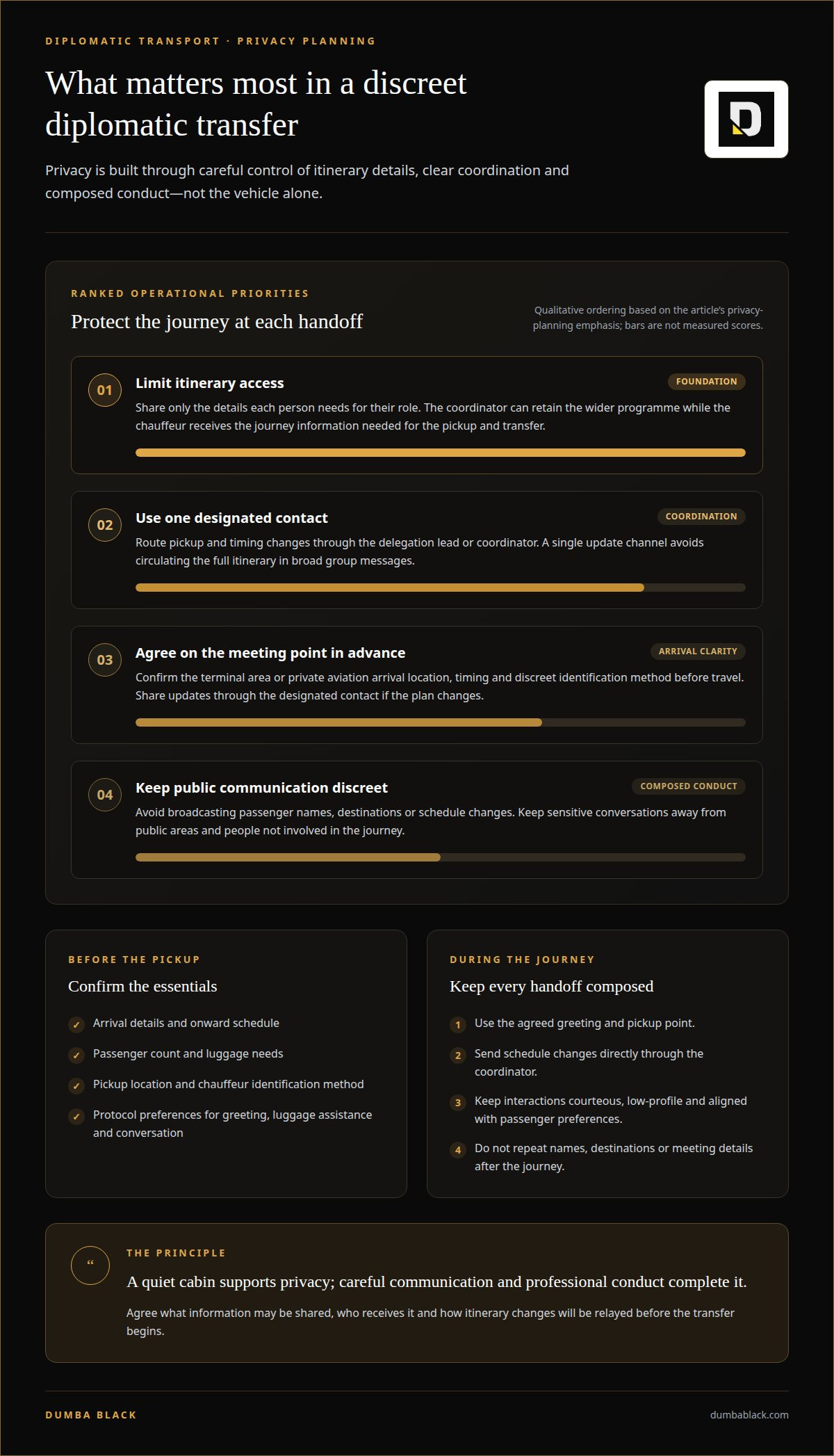
Privacy starts with controlling who receives the itinerary. For private transport for diplomats, share flight details, pickup instructions and destinations only with those coordinating the transfer. Use one designated contact for changes. Avoid circulating passenger names and the full schedule in broad group messages. The delegation lead can retain the wider programme while the chauffeur receives the details needed for the pickup and journey.
At an airport, agree on the meeting point and identification method before departure. For example, a delegation might choose a specific terminal exit, then have its lead contact tell arriving passengers where to find the chauffeur. Keep names, onward destinations and schedule changes out of public conversations. For private aviation, confirm arrival location and timing with the flight coordinator, then pass relevant updates through the designated contact.
According to the U.S. Environmental Protection Agency, air taxi services negotiate departure times and locations with customers and use aircraft with 30 or fewer seats. That flexibility makes precise coordination important: the transfer plan should reflect the agreed arrival location, passenger requirements, and onward schedule. A single point of contact can relay changes without distributing the delegation’s complete itinerary to every person involved.
New York airport transfers need additional planning during high-demand periods. Vehicle supply, access restrictions, security activity and street closures can affect operations. Share the airport, terminal, arrival details, passenger count, luggage needs and destination with the transport coordinator. Set a clear pickup point and a discreet way to identify the chauffeur. If the arrival plan changes, use the designated contact rather than posting the update in an open group chat.
- Limit itinerary access: Share only the details each person needs for their role.
- Agree on the meeting point: Specify the terminal area or private aviation arrival location before travel.
- Use one contact: Route timing and pickup changes through the delegation lead or coordinator.
- Keep public messages discreet: Avoid broadcasting passenger names, destinations, or schedule changes.
These steps support discretion without relying on the vehicle alone. At John F. Kennedy International Airport, for example, a defined meeting point and direct update channel help passengers and chauffeur coordinate without sharing sensitive details publicly. The same approach works for private aviation arrivals: confirm the pickup location, timing and onward destination with the appropriate contacts before the journey.
Confidentiality and discreet service
Discretion depends on conduct before, during and after a journey. A clear communication plan, restrained conversation and careful handling of itinerary details help limit unnecessary exposure.
Discreet Service
A discreet chauffeur keeps interactions courteous and low-profile, from greeting passengers to arriving at a venue. For example, the delegation can agree on a neutral greeting and a specific pickup point in advance. The chauffeur then follows those instructions without announcing passenger names or discussing the visit in public. Consistent conduct matters at hotels, meeting venues and airport entrances.
Consider how the service handles routine moments, not just formal arrivals. A chauffeur who waits without drawing attention, confirms changes through the designated coordinator and avoids unsolicited conversation supports a composed journey. Passengers can also state their preferences for greetings, luggage assistance and conversation. These details help align the service with the delegation’s protocol and personal boundaries.
Privacy and Confidentiality
Privacy means limiting access to sensitive details. A delegation coordinator can share only what is needed for the journey, such as pickup time, destination and passenger count. The coordinator can keep the full programme. This reduces unnecessary circulation of meeting locations and schedule changes among people who do not need them.
Choose one communication method and a single contact for itinerary updates. If a hotel meeting changes rooms, for example, the coordinator can send the update directly to the chauffeur rather than posting it in a broad group chat. Avoid discussing sensitive topics within earshot of other passengers or venue staff. A quiet cabin supports privacy, but passengers must also use discretion.
Before travel, agree on what information may be shared and with whom. Practical points include how the chauffeur identifies the delegation, whether to use names, and how to relay schedule changes. If a passenger’s plans differ from the main itinerary, communicate that privately. Clear instructions help prevent accidental disclosure during handovers or multiple stops.
A concise confidentiality protocol can cover the following:
- Itinerary access: Share journey details only with people coordinating transport.
- Passenger identification: Agree on discreet greetings and meeting arrangements.
- Updates: Route changes through the designated coordinator.
- Conversation: Keep sensitive discussions away from public areas and unrelated passengers.
After the journey, avoid repeating names, destinations or meeting details in casual conversation. A transfer may include a hotel, airport and official venue, so each handover calls for the same discretion. These habits make confidentiality a practical standard of conduct, not a vague assurance.
What information is needed to plan transportation for a diplomatic delegation?
A workable plan starts with a complete movement brief. The delegation coordinator should provide the itinerary, passenger requirements, protocol preferences and one contact for updates.
Start with the movement schedule. List each pickup point, destination, meeting time and planned stop in sequence. For example, a morning airport arrival followed by a hotel check-in and ministry meeting needs separate pickup and staging instructions. Note which timings are fixed and who can authorize changes. This helps the transport coordinator plan for the delegation’s full programme, not just its first journey.
Next, provide the passenger and luggage details needed to assign suitable vehicles. Share the number of travellers, seating arrangements, luggage volume and any mobility considerations. Where practical, identify the principal, accompanying officials and support personnel by role. If one passenger needs to leave earlier, record it as a separate movement rather than assuming the whole party will travel together.
- Itinerary: Provide locations, sequence of stops, meeting times, and expected journey changes.
- Passenger plan: Note passenger count, seating groups, luggage, and mobility needs.
- Protocol: Explain forms of address, arrival order, greeting preferences, and who leads each movement.
- Coordination: Name the delegation lead and establish how updates will be sent.
Agree on protocol details with the advance team before travel. Identify who meets the vehicle, where it may wait and how the principal should be greeted. For example, the advance team can brief the transport coordinator on the venue entrance and the order in which officials leave the vehicle. Keep sensitive itinerary details within the coordination group and send operational updates through its designated lead.
Driver vetting should assess professional conduct and readiness for the assignment. Review identity, driving credentials, relevant experience, route familiarity, communication style, and discretion. Ask how the driver handles a changed meeting location or an instruction from the delegation lead. A short briefing can confirm names or titles to use, passenger preferences, approved pickup points, and the escalation contact for unexpected changes.
Use a clear handover sequence: the advance team shares venue and access instructions with the coordinator, the coordinator briefs the chauffeur, and the delegation lead confirms final changes. For a ministry meeting, this clarifies the correct entrance, waiting position and passenger order. It also helps prevent conflicting instructions when an aide, security representative and chauffeur coordinate the same arrival.
Before the journey begins, review the schedule with the delegation lead and confirm the communication channel. A concise final briefing should cover the first pickup, destination, passenger grouping and who can approve changes. This gives the chauffeur a defined operational role while keeping protocol and itinerary decisions with the delegation.
Can you coordinate multiple vehicles and chauffeurs for one delegation?
Yes. A coordinated plan assigns each vehicle a clear role, passenger group and movement sequence. The delegation lead and transport coordinator should work from one shared itinerary and use a clear channel for changes.
Start by dividing travellers according to their roles and schedules. A principal may need a dedicated executive sedan, while accompanying officials travel together in a larger vehicle. An advance team can travel separately to prepare for arrival at a ministry or conference venue. These assignments prevent the principal’s schedule from being tied to every passenger’s movements.
Choose vehicles according to passenger numbers, luggage, journey conditions and the level of protection required. Executive sedans suit individual travellers or small parties making direct point-to-point journeys. Luxury SUVs offer a different balance of passenger space and luggage capacity. A people carrier may suit staff travelling together. Match each vehicle to its purpose rather than choosing one type for the entire delegation.
Armoured vehicles require a separate security assessment. The responsible security lead should define the protection requirement and coordinate vehicle selection with the transport plan. Consider the passenger profile, route, venue access and whether the vehicle must remain with the principal throughout the programme. Do not assume an ordinary luxury SUV provides the protection of an armoured vehicle.
- Assign roles: Identify the principal vehicle, supporting passenger vehicles, and advance-team transport.
- Group passengers: Match seating, luggage, and departure times to each vehicle.
- Confirm sequence: Set the order of departures, arrivals, and venue drop-offs.
- Designate contacts: Give the delegation lead and transport coordinator authority to relay changes.
For a conference with separate hotel and venue arrivals, each chauffeur needs the correct passenger list, destination, staging instructions and departure sequence. The coordinator can retain the master itinerary while each chauffeur receives only the details relevant to that vehicle. This limits conflicting instructions and supports discretion across the group.
Before departure, brief all chauffeurs together or through the designated coordinator. Review the route plan, passenger assignments, meeting points and how to report delays or changes. If one vehicle is held at a venue entrance, the coordinator can adjust the sequence without disrupting every passenger movement. Use consistent vehicle identifiers and agreed pickup instructions so passengers can find their assigned car without public announcements.
After each stop, the coordinator should account for passengers and confirm the next movement. A hotel-to-meeting transfer, for example, may require one vehicle to leave ahead while others collect staff. Clear roles, shared timings and disciplined updates keep multiple vehicles working to one delegation plan.
Transportation for diplomatic events and meetings
Event transport needs a movement plan tied to each venue, appointment and arrival window. For a diplomatic meeting, coordinate vehicle staging, passenger order and departure instructions with the event schedule.
Start with the event itinerary. Record each venue, entrance, meeting time, passenger group and planned departure. Identify the delegation lead who can approve changes. For a reception followed by a bilateral meeting, specify whether vehicles should wait nearby or return at an agreed time. This helps prevent chauffeurs from crowding a restricted entrance or leaving passengers without a clear onward plan.
New York City needs particular attention during high-demand periods. Vehicle supply, access restrictions, security activity and street closures can affect operations. Build the transport plan around the event’s arrival window and named venue, not just the meeting time. Include an agreed alternative pickup point and a way to communicate changes. The event coordinator should send revised access instructions directly to the transport coordinator.
For UN General Assembly meetings in New York, plan each movement as part of a connected programme. Align airport, hotel, meeting and reception transfers with the delegation’s schedule. The transport coordinator needs the right destination and passenger assignment for each leg. If officials attend separate meetings, assign distinct vehicles and pickup instructions. Keep sensitive schedule details within the coordination team.
High-level meeting transport also depends on clear staging instructions. Confirm where chauffeurs should wait, which entrance passengers will use and who signals the vehicle forward. For example, an aide can meet the chauffeur at an agreed point after a meeting, then notify the delegation lead when passengers are ready. This avoids public calls and reduces confusion when several groups depart together.
- Map the itinerary: List venues, entrances, stops, and movement order.
- Set roles: Name the event contact, delegation lead, and person authorized to change instructions.
- Plan for disruption: Agree on alternate pickup points and direct update channels.
- Coordinate departures: Match vehicle assignments to passenger groups and separate appointments.
Before the event, review the plan with the venue contact and transport coordinator. Confirm that each chauffeur has the relevant entrance, staging point, passenger assignment and update contact. In New York, this preparation is particularly useful when street closures or security activity change vehicle access. Keep the delegation’s full itinerary with its coordinator and share operational details with each assigned chauffeur.
For planned diplomatic meetings, discuss event transportation arrangements as part of the wider journey plan.
DUMBABLACK - The Spirit of Africa: Airport Transfers
DUMBABLACK, The Spirit of Africa, provides airport transfers for diplomatic travellers and delegations. Share the arrival details, passenger arrangements and onward itinerary so the chauffeur-driven transfer can fit the delegation’s schedule.
For a wider programme, Corporate Travel supports journeys between airports, hotels and meetings. Weddings & Events and Safari & Lodge Transfers serve other travel needs within an itinerary.
For airport transfer or delegation travel enquiries, contact DUMBABLACK, The Spirit of Africa, at [email protected] or visit dumbablack.com.
Social media: Follow DUMBABLACK, The Spirit of Africa, through its official social media channels.
Set the Next Journey in Motion
For diplomatic travel, turn protocol priorities into a practical movement plan. Identify the delegation lead, outline the purpose of the journey and decide which details should guide the transport arrangements. This gives your team a clear starting point for planning private transport for diplomats around discretion and passenger needs.
DUMBABLACK, The Spirit of Africa, provides Airport Transfers, Corporate Travel, and Weddings & Events transportation. These services can support different parts of an itinerary, from an airport arrival to scheduled business or event travel. Share the essential details of your journey when planning your requirements.
Refined transport begins with clear priorities and thoughtful coordination. Plan your diplomatic transportation with DUMBABLACK and take the next step with confidence.
Frequently Asked Questions
Are the drivers qualified to handle diplomatic-level expectations?
DUMBABLACK chauffeurs are defensive-driving certified, security-trained and bound by confidentiality agreements. Many have more than a decade of executive-driving experience, and drivers are multilingual. For a delegation, tailor the chauffeur’s briefing to the assignment: clarify passenger preferences, forms of address, meeting sequence and who can authorize itinerary changes. This helps translate professional qualifications into appropriate conduct throughout the journey.
How is confidentiality handled for diplomatic transportation?
Confidentiality is supported by staff agreements and discreet service practices. Before travel, designate one coordinator to share essential journey information with the chauffeur, such as the pickup point and next destination. Keep sensitive meeting details within the delegation’s planning group. For example, the chauffeur may need the venue entrance and timing without knowing the substance of a private meeting.
How is security handled without drawing unnecessary attention?
A discreet approach relies on professional conduct, planned movements and appropriate communication. DUMBABLACK’s Diplomatic & VIP service includes security-trained chauffeurs and discreet routes. The delegation can identify its security lead, agree on pickup procedures and relay operational changes through that contact. For a formal event, coordinated arrivals and discreet vehicle identification can reduce unnecessary public attention without disrupting protocol.
Is there flexibility if I need to update my plans last minute?
Contact the reservations or dispatch team when a schedule changes. DUMBABLACK provides live dispatch, allowing updated instructions to be relayed through the transport operation. State what changed, which passengers are affected and the new pickup or destination details. For example, if one official leaves a reception early, identify that passenger’s vehicle and revised departure point. Clear updates help coordinate the revised movement.
What should I know about how diplomatic transfer services work?
A diplomatic transfer is planned around the passenger’s itinerary and transport requirements. The organiser provides journey details, passenger arrangements and protocol instructions, then agrees on the vehicle and booking format. DUMBABLACK offers one-way, return and by-the-hour booking options. For a multi-stop programme, outline each movement and identify the coordinator responsible for updates. This gives the transport team a clear operational brief.
What types of vehicles are typically used for diplomatic transfers?
Vehicle choice depends on passenger numbers, luggage, itinerary, and the journey’s purpose. DUMBABLACK’s fleet includes executive sedans such as the Mercedes-Benz S-Class and BMW 7 Series, SUVs including Range Rover models, and the Mercedes-Benz V-Class for group transfers. A sedan may suit a principal travelling alone, while a van can accommodate officials travelling together. Confirm passenger and luggage requirements when planning.
How can diplomats arrange secure private transportation or an armored vehicle?
For private transport for diplomats, begin with the delegation’s security lead and define the required vehicle, passenger assignment, route plan, and coordination roles. DUMBABLACK provides Diplomatic & VIP transportation and VIP Protection. If an armored vehicle is required, make that specific requirement part of the security plan and vehicle-selection process. Do not assume a standard luxury SUV is armored; the distinction affects the assignment brief.
What security features should diplomatic transportation providers offer?
Assess the provider’s procedures and personnel, not appearance alone. Relevant considerations include security-trained chauffeurs, confidentiality agreements, discreet route planning, defensive-driving credentials and a clear channel for operational updates. Ask how the provider handles itinerary changes and coordinates with the delegation’s designated security contact. For example, a written movement brief can specify who approves changes and what information each chauffeur needs.


